Daily Photo: August 24, 2008

The deadly beach at Morcambe.

The beach here in Morcambe struck me with its monochromatic, desolate beauty. In that beauty is a terrible danger, also; the flatness of the land means the tides come in at an astonishing rate, and there was once a case of people drowning because they were unable to outrun it.

Tales of Despair: Eternal Blood

The Vampire – Philip Burne-Jones

I was one of the (probably many) goth kids who grew up obsessed with all things dark; lord amongst the demons and monsters were, naturally, the vampires. What a beautiful romance these creatures held; to live eternally, at the price of the blood of your fellow men and women. The visceral attraction of blood, warm and flowing, the bitter metallic taste, the swoon of the letting – these were the things that captured my mind.

With this came the gloriously evil tales – not only the fantasies of Nosferatu and Dracula, but the terrifying histories of Vlad the Impaler, and the Countess Báthory. Drinking, bathing, delighting in blood – all was dark, brooding, and beautiful. A natural part of this was the romanticism of the vampire, and I will hold my hand up and say that I watched many vampire movies – notably Francis Ford Coppola‘s Bram Stoker’s Dracula, long before reading of the literature.

Gary Oldman as Dracula (1992)

Francis paints a picture of a medieval man, tortured by war and death, renouncing god for eternal life upon the suicide of his one, only, true love – that he will await her forever, fed on the blood of men. And wait he does, until by happenstance, he sees her likeness in Mina, the fiancée of Jonathan Harker, a minor solicitor visiting his Transylvanian castle. Determined to fulfill his prophecy, he abandons Jonathan to his fate amongst the vampires of his castle, traveling to England in a desperate attempt to be with her. He meets with her, charms her, and seduces her – only to be torn apart again as she leaves him to be wed to Jonathan (resulting in one of the most memorable performances by Gary Oldman, weeping in agony over his loss of her).

Yet his work is done; she remembers him, and becomes infatuated, and begs him to transform her as well. And then, as she begins to change, Dracula retreats once more to his home. Now bound to him, Mina can think of nothing else, and Jonathan, now accompanied by the delightful Anthony Hopkins as Van Helsing, realize they must pursue and destroy the count if they are to save her. In the bitterest of endings, the wounded Dracula begs his long-lost love to give him peace, and – having lived to see he beloved one last time – he is put to death by her own hand.

First edition of Bram Stoker’s Dracula

Little did I know how little – and how much – this romanticized tale had in common with Bram Stoker‘s brilliant and seminal novel from 1897. While the characters remain the same, their intentions, motivations and desires could not be more different. Strikingly told from the perspective of journal entries and newspaper clippings, the loose plot is similar – Jonathan Harker, the newly-appointed solicitor, traveling to Transylvania to aid the Count Dracula in finalizing his purchase of land in London, and to teach him the ways of the English. Gradually ensnaring Jonathan in his castle with the three vampiric sisters, Dracula comes to London – for the pure desire to live amongst the great population, and to feed at his leisure.

Dracula does turn Mina, but not out of any romantic desire – it is a punishment, revenge against the men who would destroy him. He uses her, tracks his foes through her visions. In doing so, however, he betrays his own intentions, and is eventually hunted down and destroyed.

By all accounts, Bram’s original text is heart-stopping and gripping; the format of its writing ensures the survival of no character, for there is no narrator. We are left until the very end to know, even, whether the party of vampire hunters have triumphed over the bloodthirsty Count. In some ways, Francis’ version is one filled with emotional torment, anguish and despair – to pine for a lost love for four hundred years, only to be denied a life with her in the final moments is a heartbreak of unsurpassed proportions. Yet Bram’s original tale is by far the most frightening, and reeks of an entirely different form of despair: the knowledge that you are fighting an all-encompassing evil, one that delights in the destruction of all men.

Tales of Despair: The Dancing Dead

Dance of Death, by Michael Wolgemut

There is little more terrifying than the thought of the dead risen; grim skeletons, grinning with their scythes and bearing down upon you, inescapable.

Death was everywhere in the fourteenth century. For a hundred years, France and England had been pitting their men against each other, drenching the earth with blood and filling graves with the mutilated bodies of the wounded. The crops grew poor, and the poor grew hungry; famine and disease were rampant. And most terrifying of all, a death that crept upon the young and old alike, one that grew great boils upon the skin and moved from person to person with frightening swiftness. The plague decimated nearly half of the European population during its time, and the lives of men hung by a thread.

It is against this background that the first records of the Totentanz, the Dance of the Dead, are known. In a cultural landscape dominated by murder, war, adultery and disease, people grew suddenly terrified of god’s wrath, knowing they could be struck down at any moment. In an effort to find reprise from the horrors of life, the vision of one, last moment of joy, even on the way to the end, swept across the lands: the final dance to the grave.

In these times, where salvation was futilely sought in the houses of god, the hymns of mass began to see the introduction of a new plainchant: the Dies Irae. This melody, full of gloom and storm, speaks of the wrath of god, the day of judgement and the ending of the world.
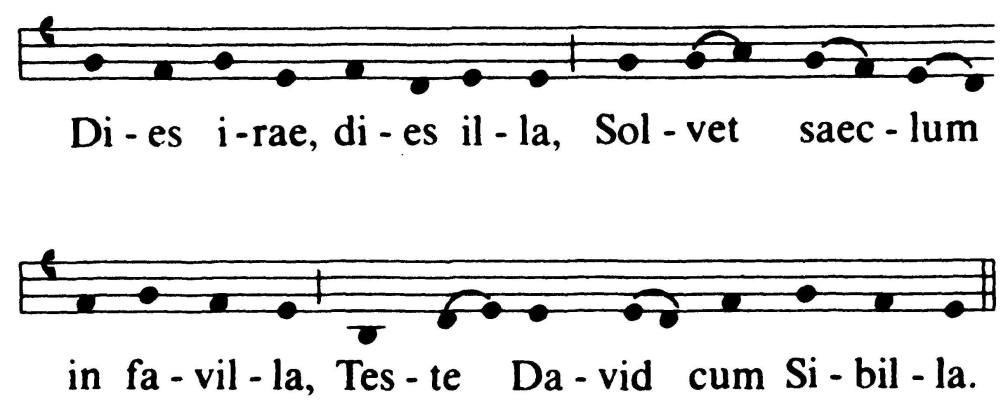
Original Dies Irae plainchant (c. 1260)

These sights and sounds of horrifying death endured, and nearly six hundred years later, were still incorporated into the art of the Romantic era. Franz Liszt (1811 – 1886) was one of these artists: an eccentric, infamous and exceptionally talented pianist and composer. He was the rock star of his day, sought after to perform, dazzling men and women alike with his superhuman pianistic wizardry (Liszt had enormous hands, and to this day some of his scores remain unplayable due to the stretches required).

Part of the original manuscript, in Liszt’s hand, for Totentanz for Piano and Orchestra.

Liszt was also a macabre individual fascinated by death and the medieval; he would often visit asylums, hospitals and even the dungeons of condemned prisoners, fasciated by those on the edge of death. Many of his works show the influence of these thoughts, but perhaps none more so than the dismal, thunderous and terrifying Totentanz for piano and orchestra. A set of variations on the Dies Irae plainchant, it begins with a rumbling, indiscernible piano, across which cuts the lowest instruments the orchestra has to offer, growling the Dies Irae with threatening ferocity. From there, we are swept away on a journey of madness and death, the pianist battling frantically against the inexorable march of the orchestra, flying to great heights and abysmal depths in an attempt to flee. At times, we are taken to one side, shown a moment of compassion, a moment of sadness, or even of humor – but always, we return to the rush and the doom.

Finally, the work builds to a frenetic climax, the pianist and orchestra verily trembling in fright, before plunging, without compromise or reprise, into the depths of the grave.

Liszt’s Totentanz is one of the most technically difficult pieces he ever wrote, and one of the darkest. Only some of his late compositions for piano, such as Nuages Gris, truly suggest a maudlin resignation to the ending of life, while many more of his compositions center around the country tunes of his native Hungary, and the sparkle and showmanship that gained him such fame that he wanted for nothing by his mid-forties.

Nonetheless, Liszt remained obsessed with death until the ending of his own life, in 1886. In his last years he suffered from many illnesses, some of which left him partially paralyzed and unable to play. His preoccupation with death increased with the knowledge that his own was fast approaching, and in July, he died in his bed. He has left us with a legacy of beauty, darkness and despair, and his works remain worthy of awe to this day.