Tales of Despair: Oh, For the Dark World

The Days of Light

Once, there was a world filled with light, and love.

There was a home, whole and fine, even if it changed into different homes over the years. The home was warm in the winter and had a fire, and was cool in the summer with open windows. There were woods to explore, bikes to ride and paths to follow. There were bright toys, shades of color and paper to take them, and a pen to write down the adventures of the mind.

There were walks in the forest, great trees towering monumentally overhead, cascades pouring down through the green glens. There were great treks of many days across the mountains, soaring peaks and biting rock and shivering snow, a tent pitched by a crystal alpine lake, and the wonder of a map as it led down twisting and winding roads.

There were friends who would come to birthdays, who would bike to school and who would go rock climbing on Fridays. There were beloved teachers and caring parents, if a little overbearing. They encouraged and fostered, gave love and grew confidence. There was music, and there was writing, and there was the soar of the imagination. There was a full life, and there was joy.


The Days of Dark

And then, one day, the light and love disappeared.

The home became a prison, one that changed into other prisons over the years. The windows remained shut, and the shades were drawn. The fire became candles, lit only in the depths of the night, in a room all alone, the door locked. The woods were forgotten, the bikes gathering cobwebs. All the colors turned to black, and the toys…they turned to razors.

The trees appeared gnarled and twisted, even in the midst of summer; their towering heights now oppressed, threatening to crush and choke from above. The mountains became evil, and a jailer, a torment that prevented the comfort of a bed in a corner in the dark. The world was dim, and the sun failed to pierce both eyelid and heart.

The old friends left; new friends came, and shared the blackness of the world. They would drive to school with doom on the radio, and would go drinking on Fridays. The teachers and parents looked with sadness and despair, and all their encouragement fell on deaf ears, their love on a broken soul. There was no confidence, no hope, and the imagination saw only the ending of all life. There was an empty life, and there was misery.


The Days of Gray

And so life went on, for many years. There was no going back, no return to the days of light. The nature of the darkness changed as the homes once did, but always against a background of blackest black. There were days when life was bearable, and days when rising from bed was more effort than there was to spare.

But there was one, a single person who refused to give up. One who would not accept the lethargy, who refused to allow the darkness to thrive. She fought, and for her efforts received anger, and abuse. But in the face of this was an indomitable will, a knowledge that, free of the pits of despair, there was a soul worth saving.

And there was a child. A precious, tiny child who did’t — who couldn’t — understand the darkness. A child who did not deserve to be subjected to its despair. And that broken soul, it saw the child, and for the first time in forgotten years, knew that here was a thing to live for. The survival of this infant life was, if nothing else, the sole reason to begin to fight the darkness.

The battle is far from won. There have been great triumphs, and even greater falls. Wonderful joy when the child shows thoughtfulness and caring, and the deepest guilt and shame when it displays the same rage and obstinacy of its father. And what makes it all the harder is that, in the face of inarguable proof that the darkness must be abandoned, that broken, stained soul still longs for it with a great, empty ache. The darkness lived for too long, and is now an inseparable part of life, no easier parted with than one’s own finger.

But the struggle will continue, and it will continue because of that one, single person, and the child she gave him.


I love you, sweetie.

Satis 2012
Tales of Despair: I Know What You Screamed Last Friday the 13th on Elm Street

Having recently (and finally) signed up for Netflix, I’ve been on a bit of a horror binge. So far, I’ve worked my way through Friday the 13th parts 1-7.

Let me explain. I have a fascination with horror that goes back a long way (and may in fact be in some small way related to the problems I have today). When I turned eight years old, I wanted a sleepover party with a few of my best friends. My little brother had been born only five days before, and I was a little jealous of the attention he was getting.

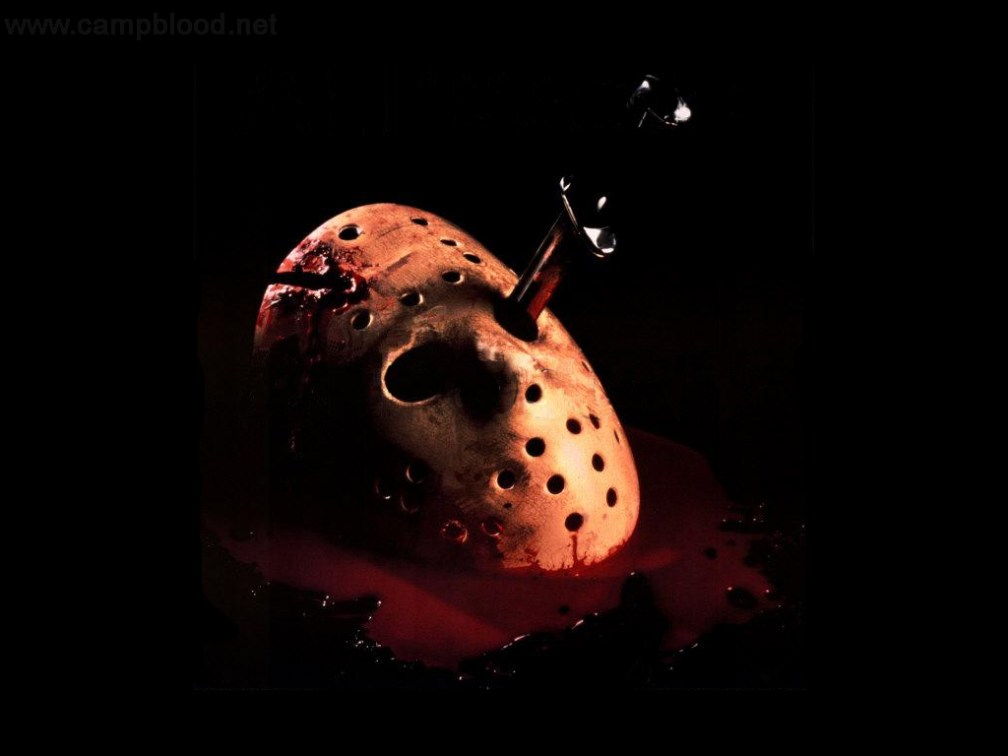
As a treat for the sleepover, my dad took us all to a video store to pick out a movie for us to watch. Being, of course, eight years old, I was looking for Star Wars or Indiana Jones or some other such adventure, and while most of my friends were of a similar mind, one in particular had a different idea. He’d heard about this thing called ‘Friday the 13th‘ from his older brother, who said it was awesome. The video cover certainly didn’t look awesome.

To cut a long story short, I to this day have images from that movie burned into my brain, and I had nightmares for the following two years. I still don’t understand why my dad let us rent it.

It was another eight years before I tried my stomach at horror again. And slowly, I acclimatized myself to their style. From The Relic to Alien to I Know What You Did Last Summer, I took them all in, and ultimately came to enjoy the darkness, the suspense, and the horror. (It’s also quite possible that this shift in taste came about as a result of my ever-increasing depression.)

However, I never returned to Friday the 13th, until now. And watching them in hindsight, I of course am able to laugh at them, for what at first I took for their cheesiness, their stereotyped killers, and the abundance of dumb teenagers.

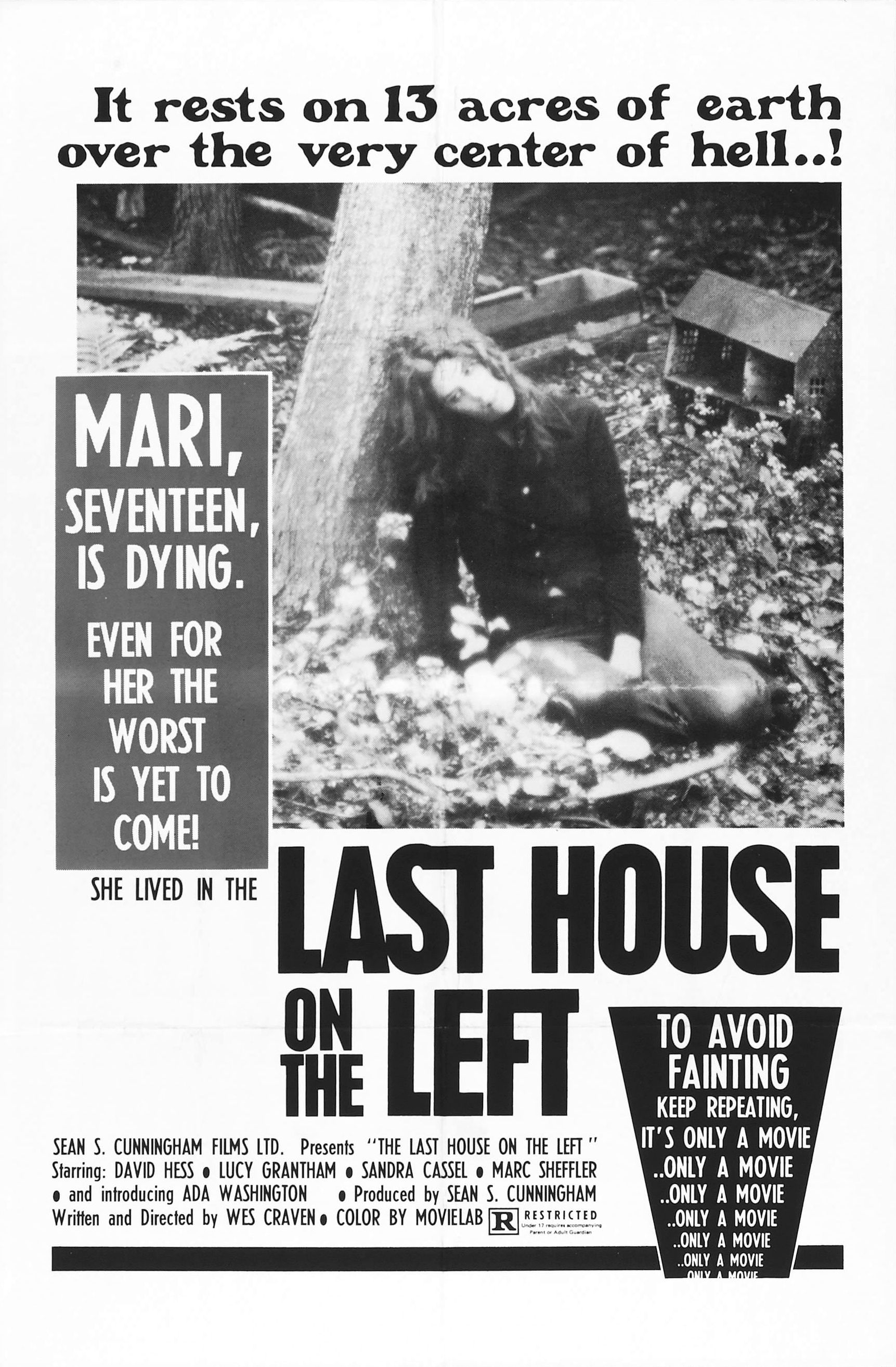
Original Poster for The Last House on the Left.

But upon further inspection, I now realize the importance of these movies in the history of horror and slasher movies. There was already a history of gore and horror going as far back as the early 1960s, but it was Wes Craven’s The Last House on the Left (1972) that really set the bar. A tale of two teenagers kidnapped, raped and murdered, it was relentless in its portrayal of some of the vilest human behavior ever committed to film. Its canon of visceral horror extends to forced sex, cold-blooded shootings, a manual evisceration, and of course, a chainsaw.

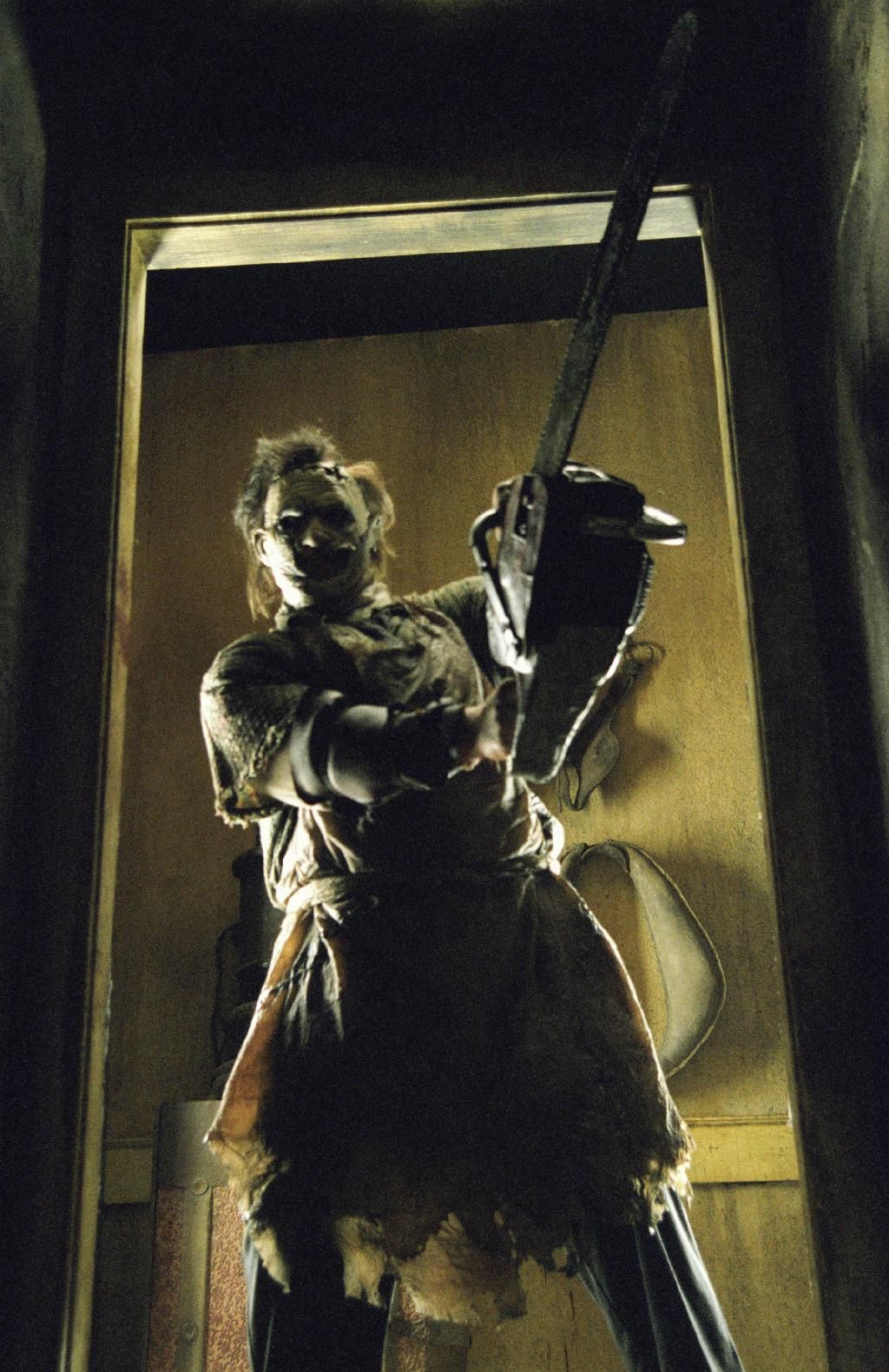
Leatherface, from The Texas Chainsaw Massacre.

Soon following this was The Texas Chainsaw Massacre (1974), which arguably invented the masked killer motif. Upon arriving on a deserted farm, a group of teenagers is one-by-one savagely attacked by the terrifying Leatherface, a fathomless killer who covers his face with human skin. Two further key developments in this film is the now-standard group of teenagers who are sequentially murdered with only one escaping, and the apparently motive-less killer. We are never given any insight into Leatherface’s intentions, reasons or history. He simply is, and this makes him of course all the more terrifying.

Throughout the 1970s these experimental horror films continued to develop, until in 1980, a seminal new slasher was released, featuring unprecedented gore: Friday the 13th. This followed on the trend of the group of teenagers, and placed them in the setting of an innocent and innocuous summer camp, albeit with a dark past. Several aspects of this film have now become such standard memes that they are recognized worldwide, and form the plot of Wes Craven’s immensely popular Scream series.

Throughout all of the Friday the 13th movies (with the exception of Friday the 13th Part 4), we are never given a view of the killer’s face. Ingeniously, Sean S. Cunningham chose only to show the killer’s feet, leaving the viewer completely incapable of empathizing with the killer, and painting him in a terrifying, mysterious light. This is vitally important to the plot in the first film, and plays an important scare factor in the sequels.

A further theme throughout the films is that of sex. In ever Friday the 13th film there is at least one, if not several, sex scenes, typically graphic. In each, the couple in question are murdered either during, or shortly after, copulation. This gave rise to the memorable quote from Scream:

There are certain rules that one must abide by in order to successfully survive a horror movie. For instance, number one: you can never have sex.

Scream – the film that rebooted the slasher movie.

Also present in most Friday the 13th films is the conclusion featuring a drawn-out chase between the killer and the sole remaining victim (usually a female). Often this involves the victim making their way into an inescapable position (for example going upstairs, where there are no exits), yet somehow escaping nonetheless.

Slasher films gradually faded from the mainstream after the 1980s, until Wes Craven (remember him? Last House on the Left – the one that started it all) rebooted the entire genre with Scream (1996). This led to a resurgence of imitators such as I Know What You Did Last Summer, and even the comedy spoof Scary Movie.

Of course, there have been many other styles of horror besides slasher films; Alien set the stage for graphically violent science-fiction horror, while Jaws, all the way back in 1975, rebooted the ‘Creature Feature’ genre of the 1950s and 1960s. However, there is arguably no genre that has spawned so great a canon of sequels (Friday the 13th has twelve – where’s the thirteenth?) and imitations, some classic (Halloween), some not so much (Cheerleader Camp). Even bizarre films such as Child’s Play followed suite from Friday the 13th, and in many ways, the past thirty years of horror owes its existence to these terrifying films.

And let’s not forget Nightmare on Elm Street

Why, hello, Freddy…

Tales of Despair: Garden of Hell

Some time ago, I wrote about discovering Pieter Bruegel’s The Triumph of Death; a vast, melancholic landscape of horror, with the dead come back to drag the living down to hell. He portrays a hopelessness in death – there is no escape: peasant and king, saints and sinners, all succumb.

As I learned about Bruegel‘s fascination with hell, it brought my attention to the one who significantly influenced his style and subject matter: Hieronymus Bosch. From an earlier generation (Hieronymus died around 1516; Pieter wasn’t born until 1525), he was born and raised in the Netherlands to a family of artists: his father and four uncles were all painters, as their father had been also. In this early stage of the European Renaissance, the Netherlands appeared to be more tolerant of the representation of death, demons and hell – with their frankly grotesque, disturbing and often mind-bending caricatures of men and devils, it is easy to imagine his work denounced as heresy, or worse, the influence of the devil himself.

Though there is no reason to believe his childhood was less than ideal, a great fire in his home town when he was but a boy laid waste to thousands of homes. One can only imagine the terror and devastation of a fifteenth-century village, flames spreading from roof to roof, as men valiantly throw water from buckets onto the ever-blackening homes. Caught in the living hell, thousands must have perished, screaming and burned alive. And when all was over, the horror of stepping through the smoldering ruins, blackened and charred bones lying side by side with the beams of houses. From this, it is suddenly easier to imagine the influence for his work.

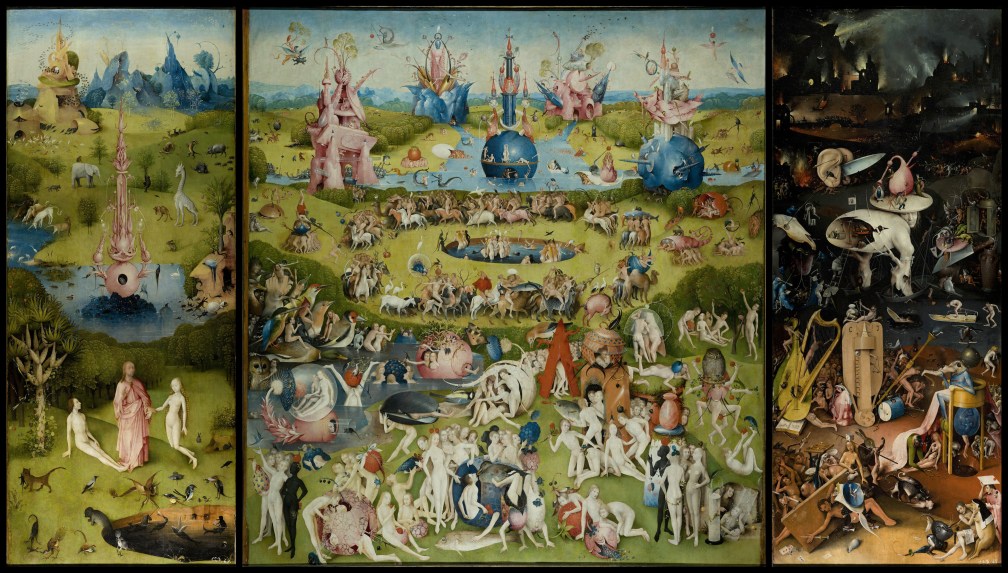
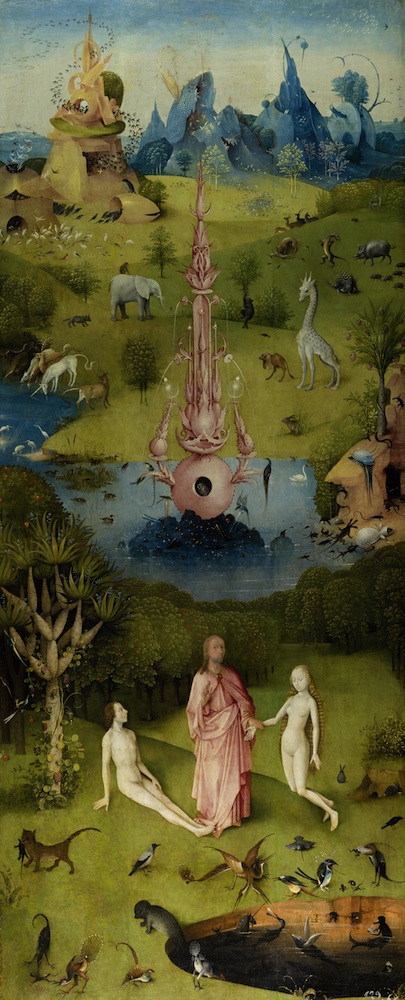
One of his best-known works today is the seminal Garden of Earthly Delights (doom metal band Cathedral pay wonderful homage on their album, The Garden of Unearthly Delights). It is a monumental piece, a staggering seven feet high and thirteen feet across, oil painted on wood, with hinges that allow it to be folded closed. Thus separated into three parts, Hieronymus dedicated each third to depicting a stage of mankind’s journey from conception to corruption to death. The left-most panel – the simplest, in terms of content – is dedicated to the garden of Eden, replete with newly-made animals, luscious lakes and fields, and azure mountains in the far distance. Orchards and palm trees sway (did they have palm trees in the Netherlands?), and in the foreground, Adam sits, watching as God presents Eve to him, new and pure and virgin.

Adam, Eve and God in Eden.

Even here, the surreal nature of his work can be seen; while some animals are recognizable, others appear as odd or deformed creatures, including three-headed lizards, deformed snakes, and some creatures that are beyond recognition.

Bizarre and distorted creatures, even here in Eden.

The central panel, twice the width of the side panels, is given over to – perhaps – paradise. It is a busy scene, with nude folk cavorting endlessly far into the distance. Here already, the scene is already becoming unsettling; though at first it appears that the beauty of Eden has grown to accommodate the growth of man, there are signs that not all is well.

The central pane – the defiling of paradise.

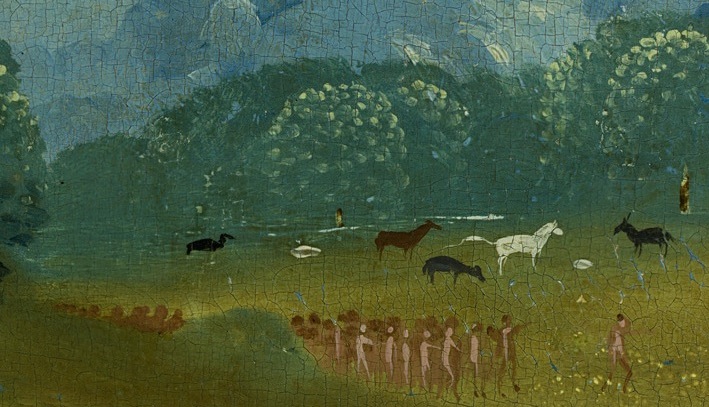
Not a man or woman can be seen toiling or working, and in their play, there show the signs of corruption, sin and vice. On the left of this panel there are depictions of good; in the far distance, groups of people can be seen entering upon paradise, among the unadulterated animals we know so well. A couple sit side-by-side on a giant pink sculpture, and a man even flies high above the world on the back of a griffin, holding aloft a branch of peace.

The sinless entering paradise – soon to be corrupted.

Yet as we move along, things begin to run afoul; men have begun to abuse their power over the beasts, riding them for their own pleasures. At the same time, their very pleasures become more bestial, as the eat from the beaks of birds, and appear even to seek congress with fish.

Um…is that what it looks like?

And of course, in the far right the ultimate symbol of sin: man taking the forbidden fruit.

The final, ultimate sin.

And so we enter the depths of hell, and it is here where Hieronymus’ true talent – and most bizarre and terrifying imaginations – is revealed. From severed feet to living consumption to grotesque violations, every detail is intended to shock and horrify.

Horror in the bowels of hell – all are equal in torment.

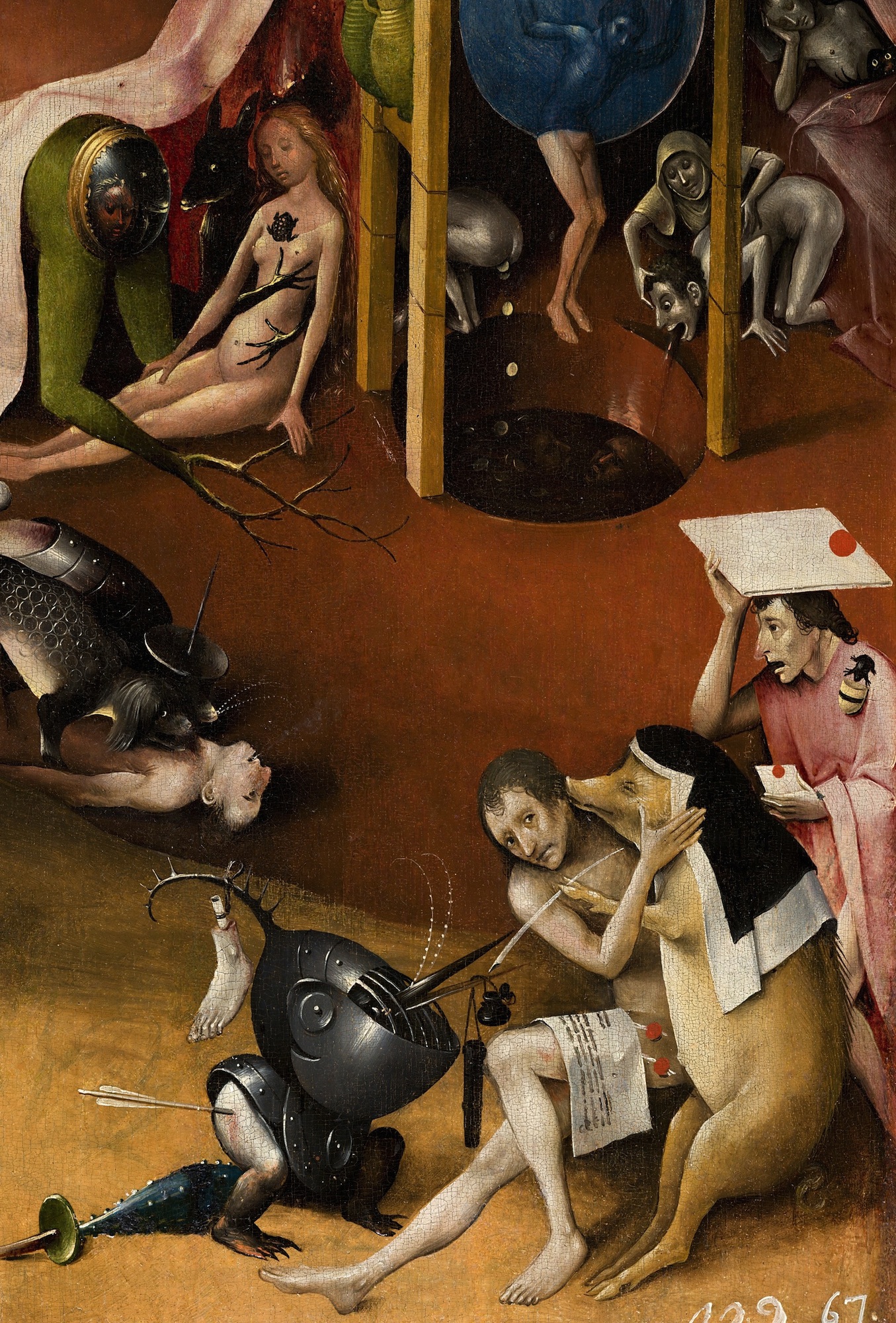
In one corner, a man makes love to a pig, while behind him misers defecate money into a cesspit in which further sinners can be seen drowning. Beside them, a hideous demon gropes an unconscious woman, while a donkey looks on.

Lust and avarice – tortured by their sins.

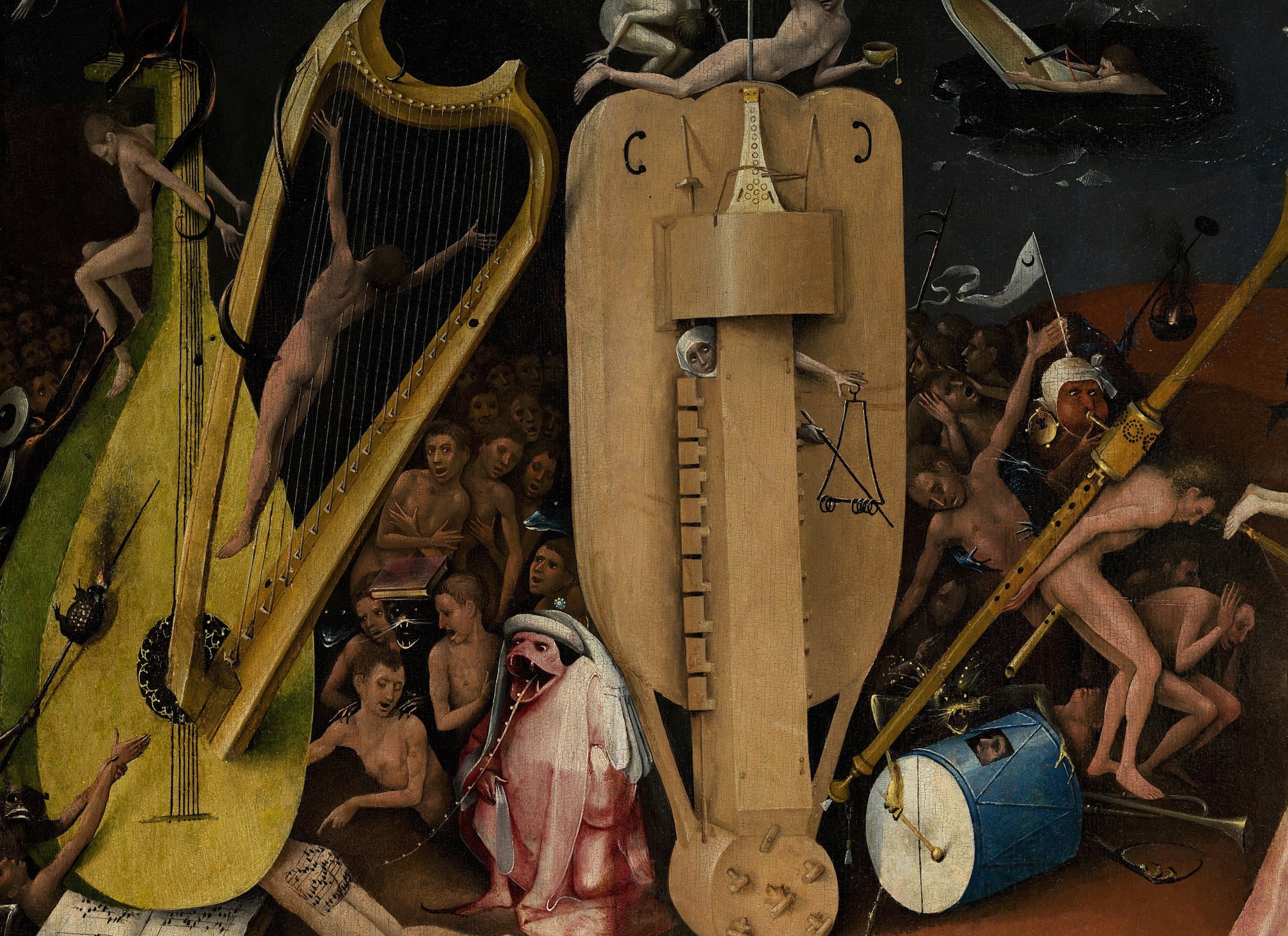
Elsewhere, musicians are impaled upon their own instruments, and tormented by the demonic music now passing through their ears.

Even the musicians are not spared.

In the center of the panel, a bisected giant forms the setting for the damnation of gluttons and soldiers alike; men are led into a fiery cavern to feast upon embers and ash, below whom tortured souls drown below the frozen waters. To their right, demons impale, imprison and feast upon soldiers – those who would kill for glory.

The fates of gluttons and killers.

But it is at the top of this panel, in the darkest and most frightening place imaginable, that the true despair of hell is shown. Lost in dark fog and shadows, the fires of hell burn high, and men are whipped, burned and massacred. Torn limb from limb, they are thrown into rivers or cast into flames, and always new sinners fall from the world above.

The distant and terrifying depths of hell.

Most heartbreaking and tormented, though, of all this, is a tiny detail at the absolute height of hell: behind the terrible black cliffs, the light of salvation glows – forever unattainable. Despite this, a single, solitary man braves the flames and the heights, desperately seeking redemption. And above him, an angel plummets from heaven.

Unattainable salvation.