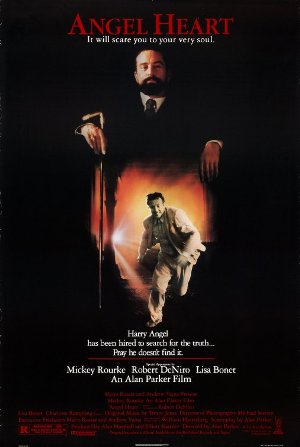
Tales of Despair: Angel Heart

Post-war, times are tough. His clients are few, and those few are poor. His investigations rarely amount to much.

The suave and sinister gentleman who hires him, however, pays well. Cash, some in advance – irresistible. It’s simple enough; a pre-war big band singer had a contract with the gentleman, but suffered brain damage during the war. The hospital says he disappeared – conveniently preventing the contract from being fulfilled. Find the singer – simple enough.

And then the singer’s doctor blows his brains out. Too much – murder isn’t down his alley.

Five thousand dollars changes that. He keeps going, keeps asking questions. Following those who knew the singer, he ends up in New Orleans, desperate to track the man down. And as he goes, further people end up dead. Could the singer be killing his former friends, to prevent himself from being discovered?

Eventually, the private eye uncovers a terrible truth – the singer, a voodoo heretic, had made a deal with the devil in exchange for fame. His wartime injuries lost him his stardom, but also prevented the devil from collecting on the deal.

Unwilling to believe this insanity, he seeks out the woman who was once the singer’s lover – to find her dead. Panicking, he searches her room, desperate to find any evidence – and comes upon a dog tag…with his own name upon it.

Reeling, he returns to the gentleman, hoping to find understanding. And understanding he gets – he was the singer, and now remembering, the gentleman – the devil – is free to cash in on the deal. A girl is found murdered in his own apartment; he is arrested; he is to be executed.

And when he dies, he descends, into the basements of hell.

Angel Heart (1987) is a masterpiece of darkness, a tale of insanity, of panic, and of evil. Set against the background of 1950s New York and New Orleans, Alan Parker’s genial directing paints an intensely moody and grim atmosphere, wholly dragging the viewer into the slow descent into madness as we follow Harry Angel on his circuitous – and ultimately fruitless – investigation of himself.

Mickey Rourke – pre-bashed-up boxer Mickey Rourke – is phenomenal, entirely convincing as the amnesiac private investigator; hard, sure and competent, the nature of his character at the start of the film only serves to contrast all the more with the power the devil has to drive any man to madness. And Robert DeNiro, though appearing essentially as a supporting role, is perfect: no one else could play the devil as he does.

Angel Heart is a movie of despair and depression; there is no happy ending, no get-out clause or last-minute rescue. Harry Angel is drawn into a sordid world of voodoo, murder and conspiracy, only to find that it was the world he left and forgot in the first place. It is gripping and graphic, and well-worth the watch. Just don’t expect to be happy at the end of it.

A Gothic Symphony: Introductions

If he hadn’t known better, he would have thought it was a setup. Considering where things ended up leading, it might as well have been. All of it, just to meet that one girl.

Marlon was crazy. He owned a huge apartment in the expensive part of the city, and no one really knew where he got the money; he worked at a divorce attorney office, the kind that don’t require a spouse’s signature. He had first met Marlon when he still worked at the big law firm, and he’d fallen in with him right away – the guy knew how to throw a party.

He never quite figured out why Marlon left; something to do with his boss, who Marlon had never really liked. In his mind, that didn’t really justify leaving a cushy job with an almost infinite upward path for a downtown crap shack that got people out of your life for $300. There was no way he was making any decent money there, even if they kept things off the books (which was pretty likely). It didn’t change a thing; he’d kept the apartment, the expensive TV and white leather couches, and he still threw mad parties. […]

Read the complete chapter here.

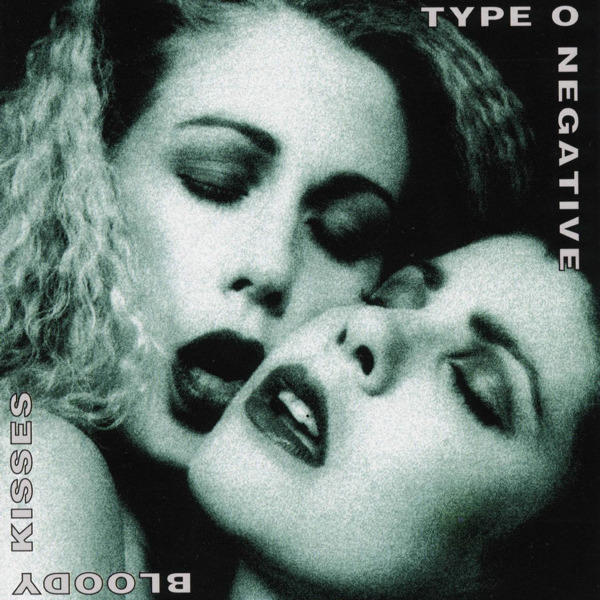
Music I Love: “Bloody Kisses”, Type O Negative (1993)

I spent most of my youth as a Goth (with a capital G), and for those of you who remember that time (or those of you who are still there), the music you listened to more or less defined who you were. In many of my hopeless and black moods, of course, there was nowhere to turn to than the wonderful misery of My Dying Bride, or the gloom-laden ballads of Sentenced. For the anger and fury, there was nothing else but Metallica and Slayer. When it was time to absolutely, once and for all I’m-really-doing-it-this-time slit my wrists, it could only be Marilyn Manson.

But, among all of these, there was one band that defined Goth more than any other I could think of, and this was the music I turned to when I simply wanted to dress in black, don the crosses and the black eyeliner, and sit moping in the back of a pub, pitying the fools who thought they were having a good time. That band was, of course, Type O Negative.

Type O Negative had a long and painful birth. As far back as 1976, four kids from Brooklyn were already gathering together in basements and garages, throwing together punk covers and goth rock. Like any young band, they went through endless lineup changes, finishing off in the eights with basically the same members as they had started out with. However, it took until nearly 1990 for their subversive music to be noticed, and their debut, Slow Deep and Hard to be released.

Ever mocking in their misery, Slow Deep and Hard featured extremely long, totally un-radio-friendly heavy metal doom, with bizarre (yet ultimately comprehensible) titles such as Unsuccessfully Coping with the Natural Beauty of Infidelity, a rather graphic song about being cheated on, to Gravitational Constant: G = 6.67 × 10^8 cm^-3 gm^-1 sec^-2, about suicide. While popular, it wasn’t until 1993 that the band truly broke through with Bloody Kisses.

A gothic masterpiece, Bloody Kisses is ultimately most famous for the title song, and the miserably humorous Black No. 1 (Little Miss Scare-All). The album extends for a full 73 minutes, passing from dark religious cynicism on Christian Woman to the bizarrely drudging cover of Seals and Crofts’ Summer Breeze, to genuine, suicidal misery on Bloody Kisses (A Death in the Family).

In hindsight (hind-hearing?), every song on this album is excellent, including the disturbing interludes such as Fay Wray Come Out and Play and Dark Side of the Womb, but at the time, the songs that truly spoke to me were those drenched in gloom and blackness. Black No. 1, so titled after the popular hair dye, references everything stereotypically goth from vampires to Halloween to the Munsters, and even a nod to Ministry‘s 1984 hit, Every Day is HalloweenChristian Woman, with its rather explicit lyrics of religious control and sexual repression, spoke deeply to the sexually-desperate teenage boy in me.

The one song, however, that truly got to me, that empathized with my own misery and formed the soundtrack for the trips to the darkest places in my mind, was the title track, Bloody Kisses. A depressingly morose song about a girlfriend who had committed suicide, it speaks of the strength it takes to kill oneself, the misery of being left behind, and challenges the dogma regarding suicide as a cry for help, or for attention. Surrounded by darkness, hopelessly depressed, and hopelessly attracted to a girl who was just as hopelessly depressed as I was, the lyrics spoke my own thoughts through the song.

A pair of souls become undone

Where were two now one

Divided by this wall of death

I soon will join you yet

With my blood I’ll find your love

You found the strength to end you life

As you did so shall I

 Bloody Kisses – Type O Negative, 1993

Though my mind is (sometimes) in a better place now, this song continues to hold a special place in my heart, as a reminder of just how dark the world can be. Type O Negative continue to be a favorite band of mine, and their music of darkness and depression are all the more poignant now – Peter Steele, founding member and singer, died in 2010 from heart failure, at the peak of his abilities. He was only forty-eight years old. Needless to say, there will be no further Type O Negative, but the seven albums they left us are a memory unto themselves – a biography of the misery, depression and black humor of the man who created them.

R.I.P. Peter Steele

1962 – 2010