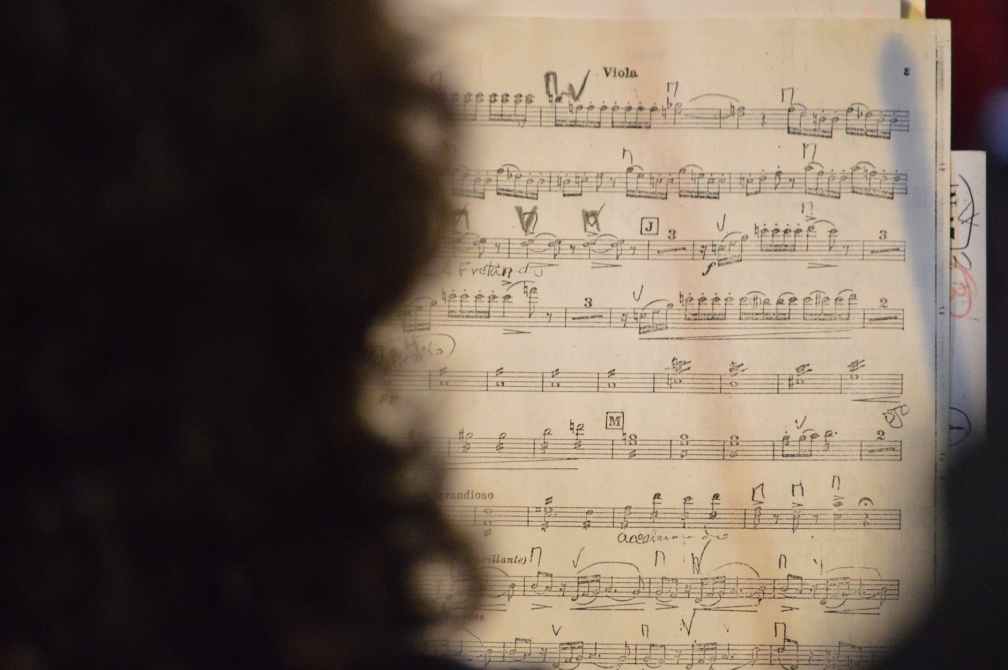
Music I Love: Symphony No. 4 in F minor, by Tchaikovsky

Work: Symphony No. 4 in F minor, Op. 36
Composer: Pytor Illyich Tchaikovsky
Year: 1878

Movements:

  1. Andante sostenuto – Moderato con anima
  2. Andantino in modo di canzona
  3. Scherzo (Allegro)
  4. Finale (Allegro con fuoco)

I’ve written before about my love for Tchaikovsky’s music – in particular the emotional drama of his sixth symphony, the Pathétique. Growing up on a musical diet of classical- and romantic-era compositions, Tchaikovsky represented to me the pinnacle of angst and turmoil, with his grandiose themes and bombastic orchestrations. Even after I discovered the high-octane energy and gothic tragedy of rock and metal, Tchaikovsky remained a staple of my musical journey, and one I frequently return to when I’m feeling emotional, dramatic, or simply in need of something more refined and cultured than blast beats.

In fairness, I could write lovingly about almost any of Tchaikovsky’s compositions – from the pomp and flair of his first piano concerto to the subtle tensions of his Romeo and Juliet fantasy overture – but one work that stands out to me, for its thematic inventiveness, intricate orchestration and Mozartian way in which the material is combined in the finale, is his fourth symphony in F minor. From the militaristic brass of the introduction to the dizzying scales of the finale, this is one of Tchaikovsky’s most musically memorable works, along with the Nutcracker suite and the 1812 Overture.

It’s also one of his leanest symphonies – even the first movement, at nearly twenty minutes long, doesn’t outstay its welcome. The material is presented, developed and recapitulated in equal measure, with each theme weaving seamlessly into the next, and yet distinct and separable all the same. As is usual for Tchaikovsky, he leans heavily on the brass instruments to carry the weight of the music, but the dancing woodwinds and dashing string scales bring a levity to what might otherwise have been overly heavy material.

The second movement, a traditional slow movement, is lyrical and sparse, a delicate balance of strings and woodwinds presenting new material whilst harkening back to the quieter moments of the first movement. The scherzo is utterly unique, played almost entirely on pizzicato strings and scattered flutes and oboes, with a short melodious middle and a recap that builds to a false crescendo before fading out into the blasting opening of the finale.

And what a finale! Crashing cymbals and screaming strings back percussive, staccato horns and trumpets at full blast in F Major – a joyous, bombastic retelling of the first movement’s dark and ominous opening notes. Furious flurries of string and woodwind scales move things forward with relentless drive, until a rising passage of frantic trumpets leads back to the original opening theme from the first movement – an unexpected and brilliant connection of the start and end of the symphony. And when the finale’s main theme triumphantly returns with double-time brass chords to close out the movement and the work, it’s impossible not to be flush with excitement and sheer enthusiasm for the breakneck pace of the music.

Tchaikovsky undoubtedly suffered from a great deal in his lifetime, and some of his works indicate a strong possibility of bipolar disorder; if so, this certainly represents a period of manic joy – a kind of feverish ecstasy, a blinding brightness that no despair can overcome, and an enduring sense that anything, any wrong, can be overcome with enough positivity.

I listen to this symphony when I need to feel energy; I listen to it when I need to feel calm. I listen to it when I need a reminder that not all in the world is doom and gloom – and, simply, when I want a break from the turn-it-to-eleven mentality of heavy metal.

This is one of Tchaikovsky’s underrated masterpieces, and I highly encourage you to seek out a good recording today.
What Have I Left Behind?

I watched a movie last night called Carrie Pilby (2016). In essence it’s about a startlingly intelligent girl who is trying to figure out her place in a world of people with half her brains and twice her wisdom. It was a cute movie, with just enough humor and drama to satisfy, without leaving you emotionally exhausted by the end. A little predicatble, perhaps, but entertaining.

And I related to it in more than a few ways, which I found surprising, because I don’t usually relate to onscreen characters. Like me, Carrie skipped grades in school. Like I once did, Carrie thought of her intelligence as something that set her above her peers (I now know that intelligence is a poor measure of a person). Like me, Carrie is sometimes depressed. She can’t relate to people, and finds social interactions exceptionally difficult.

The funny thing was that, as much as I related to the titular character, I also related to one of the side characters, too: Cy. Cy is a talented musician who hides his gifts behind humility, and despite his scruff and snark plays clarinet for one of the leading orchestras in the world. And the thought of Cy playing in an orchestra made me think back to my own youth, and what I’ve left behind.

You see, I was once a talented musician. For many years as a child music was everything, was my life and my reason for existence. I dreamed of playing Rachmaninov before crowds of thousands, and as much as I struggled to play my best, I equally enjoyed playing at my best. I gave concerts; I sang in choirs. It led me to a degree in music composition.

And then, slowly, life got in the way. The last time I put note to paper was over a decade ago. The last time I played a real piano was years ago. And whilst you don’t forget things like that, it makes me start to wonder: what was it all for?

There’s something about the creative process that innately calls to me, something that, without which, leaves me feeling hollow, and empty. There have been great periods of my life when I haven’t created anything at all, and these are unsurpisingly linked to the times of my life when my depression has been at its worst.

In recent years my creativity has come in the form of writing, either novels or blogging, and whilst writing words is arguably a lengthier, more arduous process than writing music, it bears the promise of a more immediate reward: it’s easier to get people to read your writing than to listen to your music.

That being said, I miss writing music. I miss the process of orchestration, of wondering which instruments would sound best where, and creating sounds that, until then, had never existed before. Some of my favorite compositions were for a full orchestra, whilst others were smaller, chamber arrangements; yet others were death metal in symphonic form.

I saw some time ago a post about Anthony Hopkins, and how he once wrote a waltz. for decades it went unheard, until it was finally pulled from the dusty shelves and performed for the very first time. I would love to hear my own music performed live. I would love to know what it sounds like in real life, and not in my head, or through poor computer imitations. And watching this movie returned all these thoughts to me. It made me want to experience live music again, to compose, and to create. And hopefully, I will.

It takes time, and it takes effort. It takes years of laboring in the dark before one sees the light. Sometimes the light never shines. And this thought saddens me more than any other; that what I write, what I create—it will die with me, unheard and unread by any, one of millions of stories the world over that will never see the light of day. That will ever remain on the dusty shelves.

I wonder, sometimes: what have I left behind? What life might I have had as a musician and composer? Would it have been any more fulfilling than that of an unknown writer? Or would I have languished, withered and despaired … much as I still to to this day?

I suppose there is no telling; there is no knowing ‘what if’. Nonetheless, it reminds me of how fleeting we all are, and how important it is to do the best we can each day—even if that best isn’t much. Because one day we’ll all be gone, and what we leave behind is all that will remain to remember us by.

To fight the gloom and dark, and persevere in the face of utter despair. Such is life.

Thought of the Week: Making Music

Apologies for the delay in this week’s post—and even more apologies, because I have an admission to make: I haven’t done any (any) writing in the past two weeks.

Argh!

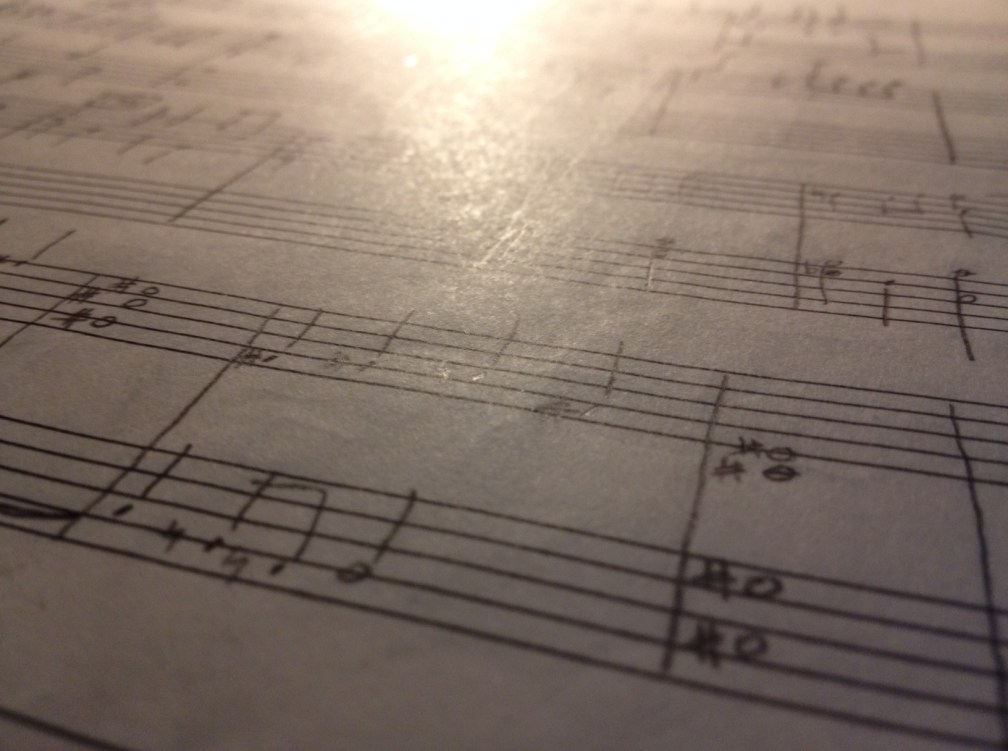
I have, however, what I hope is a reasonable excuse. Instead of devoting my time to words on paper (or computer screen), I have instead been trying my hand for the first time in many years at writing music:

IMG_0365

Did you know that I wrote music, once upon a time? Ahem … of course you knew—you’ve checked out all of my website, haven’t you? I have a degree in music composition from the University of Sheffield, and for quite some time in my youth thought I might be a professional composer.

Well … life got in the way, of course, and that particular dream never happened. Then, a few years ago the creative juices started flowing again, but what came out were not notes, but words. So The Redemption of Erâth was born.

But deep in the back of my mind, I’ve always wanted to return to writing music, and with the advent of advanced notation and recording software, I decided to revisit one of my earlier works: a symphony for full orchestra, first written when I was about fifteen.

Inspired by the likes of Beethoven and Dvořák, I had come up with a couple of melodic ideas that seemed to fit better in an orchestral environment rather than solo piano (which was my medium of choice up to that point), and so with all the enthusiasm of gusto of youth I set about writing a symphony. Full, four-movement piece, which would have totaled nearly an hour in length—had I ever finished it. I ended up with first, third and fourth movements, but never got around to writing the second (slow movement). What I accomplished was, for my age and relative inexperience, phenomenal; however, it was most certainly not publishable, never mind performable. I didn’t have the understanding of the immense variety of instruments in a full orchestra at the time.

But that’s what I went to university for. And now, with a solid background in composition and a shorter orchestral piece (that I’m actually quite proud of) under my belt from my final dissertation, I’ve decided, while the mood strikes me, to open up Logic Pro X and Finale 2014 and start making some music! It’s tedious, long-winded and thankless work—in two weeks I’ve managed to write approximately seven minutes’ worth of music. In the first movement alone, I have another fifteen to go.

But the joy of creating is the same as it always has been, and fret not—though Brandyé and Elven have taken a (very temporary) back seat, I will return to them and their adventures in Erâth.

For now, here is Symphony in F minor—so far!

Featured image from http://wallpaperswide.com/old_music_score-wallpapers.html.

Satis Logo 2014