Tales of Despair: Wyndham’s Apocalypse

Does anyone remember John Wyndham? His post-war novels set the stage for science-fiction to come, and despite H.G. Wells‘ prescient War of the Worlds,  he is known to this day as the godfather of the disaster novel.

The influence of his seven stories of terror and disaster have been felt across time and medium, being seen in future novels and films for decades after his lifetime. In particular, his first three novels, The Day of the TriffidsThe Kraken Wakes and The Chrysalids set the stage for apocalypse and disaster, and the strength of human survival in the wake of mass disaster.

Imagine the terror of waking, blind in a hospital, to nothing. No sound, no smell, no sight. Wandering through the streets of London, and discovering that every other person in the great city is equally blind. Some run in fear; some capture the few sighted in violence. Many are dead. All civilization is crumbling around you.

Then, quietly and in the distance, the whisper of monsters approaches. Towering, flesh-eating monsters that ought never to have been released. That ought not to exist. That ought not to be able to move, for they are plants. Yet move they do, and their advantage is great, for among the blind, they sense the movement of the frightened, and strike them down. Poison, stings, death and rotting flesh. Tearing humans limb from limb.

The 2002 film 28 Days Later… pays homage to this brilliantly, with Jim awaking in a hospital to the sound of silence. Stunning scenes of entirely empty London streets reflect the confusion and fright of Bill Masen, suddenly thrust into a twisted reality from which there is no waking, no escape. The fight for dominance among the few survivors parallels the dictatorial colonies of Wyndham’s post-apocalytic vision.

Paramount to these tales is the gut-wrenching realization that there is no return to normality. The world as we know it is gone, and the primal laws of evolution rise: the survival of the fittest. The weak die; the world diminishes. Hope is forsaken, and the sole thought is to make it to the next dawn.

When I first read these stories as a child, I was terrified; I saw tendrils of barbs and poison pushing gently at my window in my nightmares, insidious and threatening. I saw movement in the bushes walking home from school, and ran past the rhododendrons in fright. I haven’t read the novel again since.

However, the most heartbreaking tale of strife remains, to me, The Chrysalids. Here, the apocalypse is long-gone, and the survivors have settled into a rural, medieval society, where preservation of the normal is the law of the bible, and the deviants are hunted down and destroyed. Deviants, however, are abundant. Some are hideously deformed; some are barely noticeable. A single extra toe is cause for banishment and death. And in this setting, a new strain of human comes into being: ones who can sense the thoughts of others. The horror of being driven out by one’s own parents dominates the mood of the story, and I cried bitter tears when David, Rosalind, Petra and the others – mere children, naive and alone in the world – are gradually discovered and hunted in violence by their own families.

Wyndham had his finger firmly on the pulse of despair and hopelessness, inspired perhaps by his horrific experiences in the war, including the storming of the Normandy beaches. Such visions are indelible, and it is possible that these novels were his catharsis; the only way he knew of exorcising these demons.

His terror, his fright and his visions of destruction have inspired generations of creative artists; the world is fortunate to have had such a bleak storyteller.
Thought of the Week: Rowling’s Labryinth

My son and I just recently finished reading Harry Potter and the Goblet of Fire. I have to admit that, considering the book is several hundred pages longer than its three predecessors, I wasn’t quite sure what was filling up all those pages. It got good – very good – at the end, but I can’t help feeling that it was, compared to Harry Potter and the Philosopher’s Stone, Harry Potter and the Chamber of Secrets and Harry Potter and the Prisoner of Azkaban, it felt somewhat bland. Other than a whole lot of prepubescent love interest, nothing really happened.

We may not read the rest of the books for a while. Goblet of Fire noticeably takes a turn into darkness, and I’m not sure if we’re ready for that (ironic, considering the nature of the story I’m writing for him). Nonetheless, we enjoyed it, finished it, and moved on. We’re revisiting The BFG at the moment (which is pretty darn dark in its own way!).

Another ritual he and I have is Friday movie nights. Netflix has become an invaluable instrument in our weekly film fix, and we’ve watched anything from the awful Jackie Chan movie Spy Next Door to the slightly better The Accidental Spy, among others. This week we watched The Dark Crystal for the first time. I had not seen it before, and I must say, I was swept away by the story, the beauty and the sheer dedication of the animatics in the movie. It was made in 1982, and puts Team America: World Police to shame. In more ways than one.

Before that, we watched another Jim Henson masterpiece; one that I remember well from my own childhood: Labyrinth. Does anyone remember a terribly young Jennifer Connelly and a terribly camp David Bowie? Must have been heaven for her, I’m sure! It was a real treat to visit this surreal, acid-trip vision of my youth, and I couldn’t help pausing the movie from time to time to point out particular things to my son. Imagine having to explain David Bowie. Whew.

In the proceedings, I noticed a few other things as well. Things that rang a bell from elsewhere.

Hoggle…or Hogwarts?

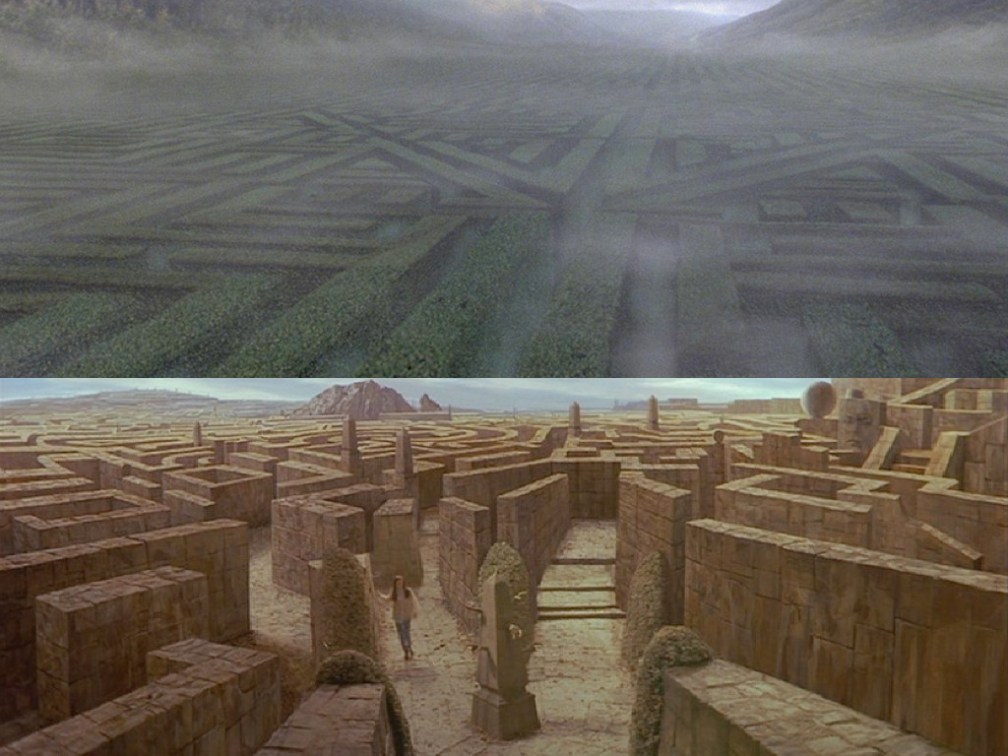
As you may have noticed at the head of the post, I have placed side by side (top by bottom?) a still from Harry Potter and the Goblet of Fire and Labyrinth. Does anyone see a resemblance? Now, surely mazes aren’t particularly uncommon – there’ve been plenty of movies and stories that have featured them, The Shining and Alice in Wonderland amongst others. Both of these predate Labyrinth and Harry Potter. In truth, at first I didn’t even see any connection.

But then, a couple of other things happened. Remember Hoggle? A grumpy, self-depricating and ultimately heroic little dwarf who guides Sarah through the maze. When we are first introduced to him, Sarah in her distraction mistakenly calls him Hogwart. Hogwart – really? This was the first coincidence I picked up on, and pointed it out in laughter – imagine they both came up with the same name!

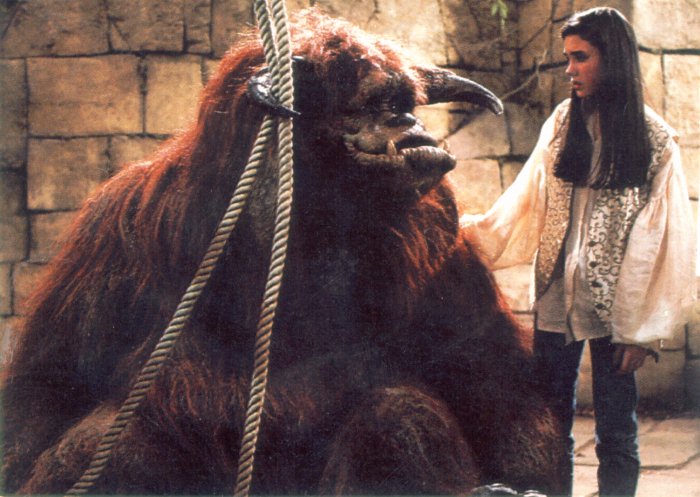
A little later, my suspicions were raised. Remember the big, hairy, somewhat dimwitted monster that befriends Sarah and has some bizarre power to control rocks? Name’s Ludo. Yes, Ludo. Just like Ludo Bagman, the Head of the Department of Magical Games and Sports.

Ludo Bagman…maybe.

They say you need at least three points to plot a graph. I wouldn’t want to go so far as to say Ms. Rowling took inspiration from Labyrinth; however, it feels these are a few coincidences too far. Two characters that share names with Rowling’s universe, and a giant maze that serves as the testing ground, and ultimately the transformation from child to adult, in both stories? I just don’t know…

Anyway, it turns out I’m not the first one to think of this, as a quick Google search will tell you. Some people see the coincidences; some dismiss them. I don’t necessarily want to make a claim either way, but just bring it to your attention: what do you think?

Tales of Despair: Perversity

The grunts of his sister and her clients ring loud through the thin partition. Emile hates her as he hates all women; women have only ever spurned him.

Later, her lover beats him, and then invites him to eat with them. Irma will not stop him, though she tends to her brother when he is gone.

Bebert does not like him, and is satisfied when Emile squirms. In the end he will stab Emile in front of his sister. Again, she will not stop him.

Emile will buy a gun, and will desire Bebert’s death; it isn’t his that comes.

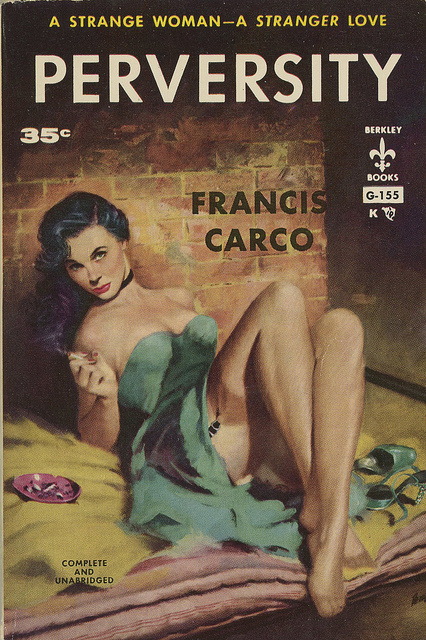
Such are just some of the scenes that bring to life Francis Carco‘s (1886-1958) frankly stomach-churning painting of 1920s Parisian slums, Perversity (French: Perversité). The story is bleak and desperate, centered around three loathsome characters and filled with little hope. Emile is a clerk, unable to function without the reassurance of strict routine. Irma is a prostitute, working from her bedroom in the tiny, two-room apartment she shares with her brother. Bebert is the bully of the tale, lording ownership over Irma and taking great delight in the torment and abuse of Emile.

What is particularly unsettling about Perversity is Carco’s unflinching dedication to the deeply disturbing faults he has built into his characters, and he allows them no redemption. Emile and Irma are pushed to edge of human decency, and repeatedly make decisions that seem against the very grain of morality, yet each time we are left with the knowing that there was, of course, no other way it could have been. One of the most discomfiting scenes occurs half-way through the story, when Bebert walks in to find Emile and Irma talking together. As Emile shrinks away from him, his sister points out that he is afraid of Bebert. Rather than allowing his characters to escape  with a mere argument, Carco builds a tension so great that it is only finally released when Bebert brings out a pocket knife and stabs Emile repeatedly, smiling all the while and insisting that such ‘pricks’ don’t hurt at all, and he shouldn’t act as such a baby. When he is finally finished and allows Irma to bathe him in salt, she comes to him and tells him that Emile is bleeding profusely. His callous response is that such a thing is “quite natural, I assure you. It’s rather the contrary that would astonish me.”

I have read no other book that so encapsulates the despair and hurt of inescapable depression, and forces it on the reader without sympathy. This is a terribly uncomfortable read, and I found myself unable to continue at certain points, often for weeks at a time. Ultimately, it was a rewarding experience, for it is a tale that draws you in and does not let go. The uniqueness of this story is that it is not tension, fear or suspense that hooks its teeth into you, but rather the grim, hopeless lives of these three people who have no reason to live, yet push on regardless in spite of the filth and the pain.

Perversity is available in print and for Kindle on Amazon. Read it at your peril.