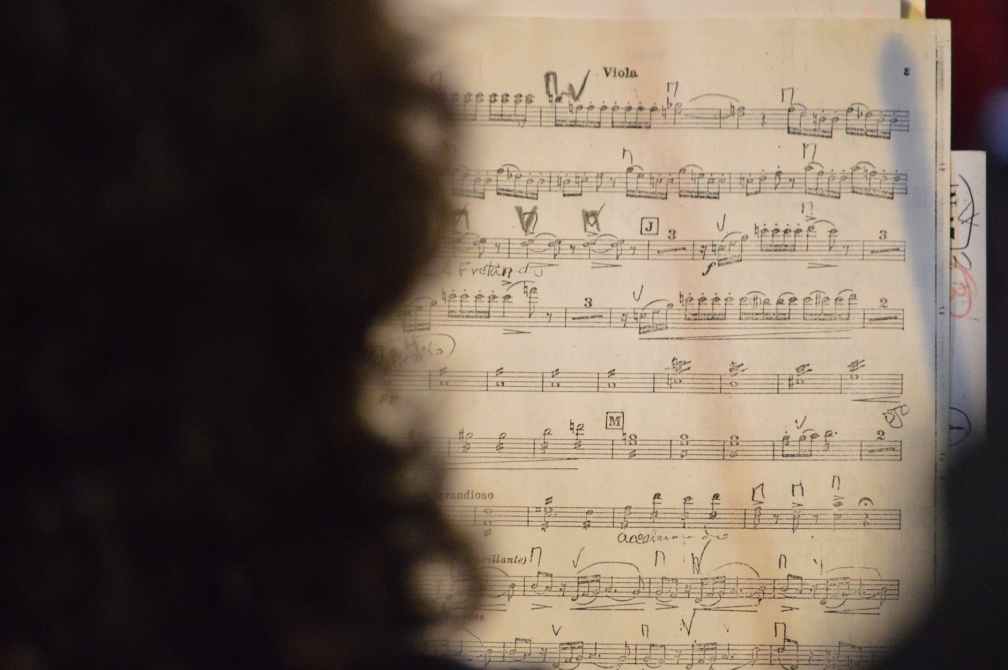
In Pursuit of Perfection

Very few things in this world are perfect. Our jobs, our relationships, our partners and ourselves – these are all subject to the (often enormous) imperfections of life, and for the most part we live our lives content with – or at least ignoring – this fact most of the time.

It doesn’t help that perfection is highly subjective; one person’s ‘perfect’ book might be another’s most-loathed prose ever. I saw a post on Reddit the other day asking for opinions on the ‘perfect’ movie; answers ranged from Star Wars to The Grapes of Wrath. Many people agreed, others disagreed, and some simply suggested their own ‘perfect’ movies.

Unfortunately, despite knowing full-well that perfection is unattainable, many of us are perfectionists anyway. I know I am – or at least, I used to be – and I know many others who share this trait with me. For me it varies from subject to subject, as I suspect it does with many; those things I’m most passionate about are the things I have the highest expectations of. Projects that mean a lot to me come with an elevated need to be as close to perfect as possible.

But here’s the thing: perfection, whilst not technically impossible, depends entirely on the scale at which one is assessing the thing claiming to be perfect. My books, for instance, are far from perfect. They contain numerous flaws, plot holes, typos (despite intense editing), and passages that, in retrospect, I wish I had written differently.

But let’s zoom in a little more. Take the following passage:

“And so it was with a lighter heart that Brandyé Dui-Erâth began to walk away from the river and away from all he knew. And so it was that, unknown to him, Darkness followed behind and laughed.”

Satis – The Redemption of Erâth: Consolation

These are the final lines of the first Redemption of Erâth book. For the style and setting, to me this is as perfect as I can make it. I adore this lines, it took me a long time to come up with them, and they close out a book of sadness and despair beautifully. These two sentences are, to me, perfect. Better still is that they form the last paragraph of the book, because it leaves the reader feeling both sadness and hope.

One of the things I’ve been doing for my alter-ego’s upcoming young adult novel is writing songs to go with it. I’ve put down the notes, played with the sound, and recorded some vocals. Again – far from perfect. Yet some of the songs I actually really enjoy. My singing isn’t great, and the guitars sound a little artificial at times, but there are the odd ‘magic moments’ that really make me think, wow – I did a good job.

The problem is that minute perfection is exponentially difficult to scale. One note, one sentence, can be perfect. But art is made of millions of paint strokes, and not every one of them can be perfect. And as artists, we have a choice: we can go back and change and improve to no end … or we can just release the damn thing and let people enjoy imperfection.

After all, a song with perfect timing will not only sound like it’s being played by a robot – a robot is the only thing that could play it perfectly. Imperfections make us human, and some of the best recordings and works of literary genius are all the better for their imperfections; they help the rest stand out all the more as the genius that it really is.

Besides – most people will never notice.

Music I Love: Piano Trio No. 1 in B, by Brahms

Work: Piano Trio No. 1 in B, Op. 8
Composer: Johannes Brahms
Year: 1854 (Original Version); 1889 (Final Version)

Movements:

  1. Allegro con brio
  2. Allegro molto – Trio (Meno allegro)
  3. Adagio
  4. Finale (Allegro)

Brahms is a fascinating composer to me; aside from the beauty and passion of his music, he was a notorious perfectionist, burning old manuscripts if he felt they weren’t up to his standard – even years after he originally wrote them. His piano trio in B – listed as his first, and only his eighth composition ever – is dated 1889, only eight years before Brahms’ death in 1897. Brahms wasn’t a particularly prolific composer – following in the footsteps of Beethoven and Schubert, but he wrote more than eight works in his lifetime.

The reason his first piano trio has such a late composition date is because it was, in fact, originally written in 1854, when Brahms was only twenty-one. A sprawling opus, it’s one of the few surviving early manuscripts that Brahms left behind; so many others were lost to his passion for perfection. Brahms rewrote the piano trio in 1889, significantly shortening several movements and almost completely rewriting others.

It’s interesting, because to listen to the two versions side by side doesn’t immediately reveal one as better than the other; in many ways, they’re simply different. The opening melody of the first movement, introduced on piano for a few measures before the cello and violin enter, is heart-meltingly beautiful, and luckily one of the things Brahms didn’t change, but it isn’t long before the two pieces diverge, and don’t really come back again at all.

It brings up the complex relationship between the artist and the audience. If Brahms had had his way, no one would ever be aware of the 1854 version of the work; we’d all only know (and the version that is most often performed, is, of course) the 1889 version. But are they two distinct works? Or is one simply a revision of the other, to be known and played whilst the original settles to dust?

Once published, who does art belong to? Does the artist have the right to retract a piece of music that, for thirty-five years, stood untouched and was beloved the world over? What happens to the original, when the new one is so significantly changed?

I don’t think there are any simple answers to this, but it is a curiosity that, in this instance, we have the ability to hear what Brahms thought was good music at twenty-one, and to hear his opinion of that same music at fifty-six (clearly he didn’t care for most of it).

As for me, I’ll gladly listen to either version – from the gloriously melodic opening of the first movement (one of Brahms’ best melodies by far) to the jittery unease of the Scherzo and the passion of the Finale, this is easily one of my favorite pieces of music in the world.

Music I Love: Symphony No. 4 in F minor, by Tchaikovsky

Work: Symphony No. 4 in F minor, Op. 36
Composer: Pytor Illyich Tchaikovsky
Year: 1878

Movements:

  1. Andante sostenuto – Moderato con anima
  2. Andantino in modo di canzona
  3. Scherzo (Allegro)
  4. Finale (Allegro con fuoco)

I’ve written before about my love for Tchaikovsky’s music – in particular the emotional drama of his sixth symphony, the Pathétique. Growing up on a musical diet of classical- and romantic-era compositions, Tchaikovsky represented to me the pinnacle of angst and turmoil, with his grandiose themes and bombastic orchestrations. Even after I discovered the high-octane energy and gothic tragedy of rock and metal, Tchaikovsky remained a staple of my musical journey, and one I frequently return to when I’m feeling emotional, dramatic, or simply in need of something more refined and cultured than blast beats.

In fairness, I could write lovingly about almost any of Tchaikovsky’s compositions – from the pomp and flair of his first piano concerto to the subtle tensions of his Romeo and Juliet fantasy overture – but one work that stands out to me, for its thematic inventiveness, intricate orchestration and Mozartian way in which the material is combined in the finale, is his fourth symphony in F minor. From the militaristic brass of the introduction to the dizzying scales of the finale, this is one of Tchaikovsky’s most musically memorable works, along with the Nutcracker suite and the 1812 Overture.

It’s also one of his leanest symphonies – even the first movement, at nearly twenty minutes long, doesn’t outstay its welcome. The material is presented, developed and recapitulated in equal measure, with each theme weaving seamlessly into the next, and yet distinct and separable all the same. As is usual for Tchaikovsky, he leans heavily on the brass instruments to carry the weight of the music, but the dancing woodwinds and dashing string scales bring a levity to what might otherwise have been overly heavy material.

The second movement, a traditional slow movement, is lyrical and sparse, a delicate balance of strings and woodwinds presenting new material whilst harkening back to the quieter moments of the first movement. The scherzo is utterly unique, played almost entirely on pizzicato strings and scattered flutes and oboes, with a short melodious middle and a recap that builds to a false crescendo before fading out into the blasting opening of the finale.

And what a finale! Crashing cymbals and screaming strings back percussive, staccato horns and trumpets at full blast in F Major – a joyous, bombastic retelling of the first movement’s dark and ominous opening notes. Furious flurries of string and woodwind scales move things forward with relentless drive, until a rising passage of frantic trumpets leads back to the original opening theme from the first movement – an unexpected and brilliant connection of the start and end of the symphony. And when the finale’s main theme triumphantly returns with double-time brass chords to close out the movement and the work, it’s impossible not to be flush with excitement and sheer enthusiasm for the breakneck pace of the music.

Tchaikovsky undoubtedly suffered from a great deal in his lifetime, and some of his works indicate a strong possibility of bipolar disorder; if so, this certainly represents a period of manic joy – a kind of feverish ecstasy, a blinding brightness that no despair can overcome, and an enduring sense that anything, any wrong, can be overcome with enough positivity.

I listen to this symphony when I need to feel energy; I listen to it when I need to feel calm. I listen to it when I need a reminder that not all in the world is doom and gloom – and, simply, when I want a break from the turn-it-to-eleven mentality of heavy metal.

This is one of Tchaikovsky’s underrated masterpieces, and I highly encourage you to seek out a good recording today.