Thought of the Week: Creepy Photoshop

The importance of cover artwork is gradually being lost, in an age where a song is an intangible entity on a twirling magnetic disk, and books are nothing more than illuminated words on a glass screen. Why would we care about a beautiful painting or sketch, when it is rendered in a two-by-two inch square on a device that rarely leaves our pocket?

Type O Negative – Bloody Kisses (1993)

There was a time when you picked the thing you wanted by the way its artwork looked; countless favorite albums of mine came simply by having seen their cover – when I saw Type O Negative‘s cover for Bloody Kisses, I simply knew I had to have it. The same was true for Danzig‘s How the Gods Kill, with its incredible, grotesque and frankly disturbing artwork by none other than H. R. Giger (he of Alien fame).

And the same, once, was true of books. At the risk of upsetting the age-old maxim, a book’s cover has a lot to say for its contents, even if it is nothing more than a gesture. The leather-bound, gold-pressed edition of Oliver Twist on my father’s imposing bookshelf sent the clear message that this was an IMPORTANT book, and was therefore very BORING. When I later discovered a copy with a lovely, friendly picture of the rascally little orphan, I devoured it.
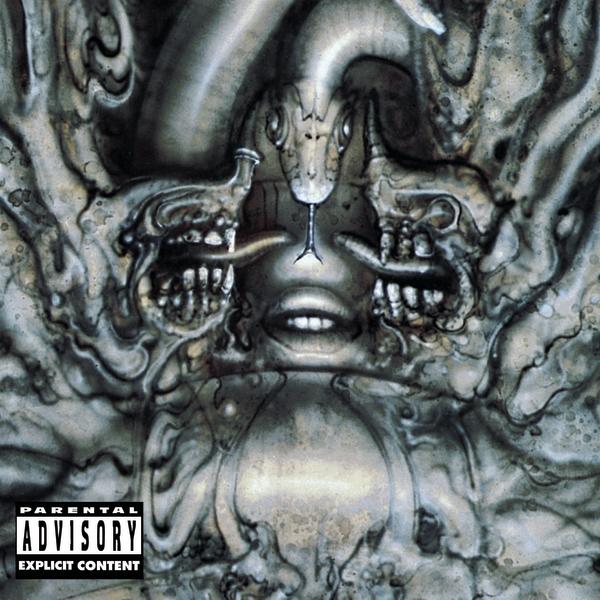
Danzig – How the Gods Kill (1992)

However, if ever there was a loss of cover artwork, it is in the realm of computer software. Long-passed are the days of buying software in a box on a shelf in a big, cold, unfriendly store, driving home, sticking the disc (or floppy, or what-have-you) into the computer, and muddling your way through incomprehensible Read-Me files and instructions before realizing that you only got the Lite version, and what you really needed was the Ultimate Pro Bonus Pack 7 (with X9 Speed-Upgrade) version. Back in the day, some software simply was mandatory, and the rest tried to sell itself on the merits of what the other stuff didn’t have.

Now, we get our computer’s capabilities from a plethora of online sources. I personally download virtually all of my applications now through the Mac App Store; it is clean, friendly, and easy to navigate. However, the artwork has been reduced to its most elemental function: an icon, a hundred pixels to a side, doing its very best to try and give us some vague notion of what the application actually does.

And in this world of instant access, many of the heavyweights of boxed software are finding themselves suddenly challenged by the newcomers. Google Docs and Open Office are taking the place of Microsoft Office in many businesses and homes; photo-editing apps such as Pixelmator and Picasa are making people question why they would spend $700 on Photoshop.

With this overwhelming choice upon consumers, the big names must step up, and convince us that their products are still worth buying. A part of this, naturally, begins with the cover artwork. If you are still going to be selling your stuff in a box, you need to make that box as appealing as possible. It ought to call out that this is a friendly product, that you’re going to feel right at home with it, like a brother or a sister or a friendly neighbor. Something that would inspire you to create new, colorful, vibrant and beautiful works of art.

Something like this?

Tales of Despair: The Dancing Dead

Dance of Death, by Michael Wolgemut

There is little more terrifying than the thought of the dead risen; grim skeletons, grinning with their scythes and bearing down upon you, inescapable.

Death was everywhere in the fourteenth century. For a hundred years, France and England had been pitting their men against each other, drenching the earth with blood and filling graves with the mutilated bodies of the wounded. The crops grew poor, and the poor grew hungry; famine and disease were rampant. And most terrifying of all, a death that crept upon the young and old alike, one that grew great boils upon the skin and moved from person to person with frightening swiftness. The plague decimated nearly half of the European population during its time, and the lives of men hung by a thread.

It is against this background that the first records of the Totentanz, the Dance of the Dead, are known. In a cultural landscape dominated by murder, war, adultery and disease, people grew suddenly terrified of god’s wrath, knowing they could be struck down at any moment. In an effort to find reprise from the horrors of life, the vision of one, last moment of joy, even on the way to the end, swept across the lands: the final dance to the grave.

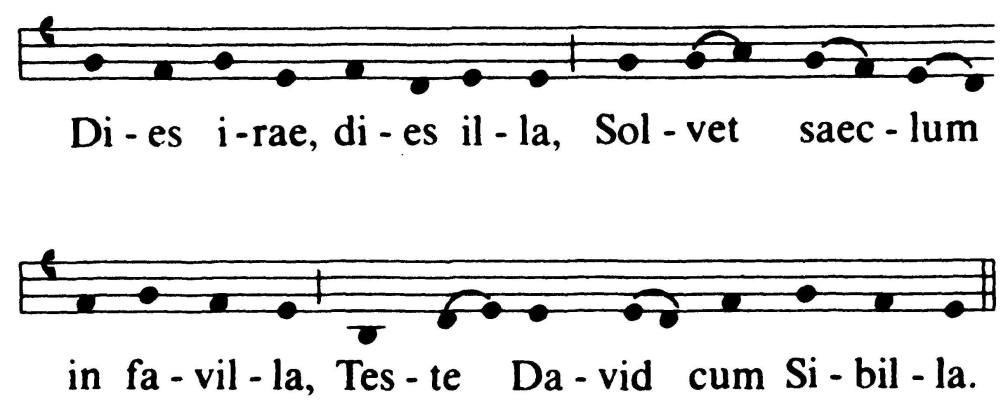
In these times, where salvation was futilely sought in the houses of god, the hymns of mass began to see the introduction of a new plainchant: the Dies Irae. This melody, full of gloom and storm, speaks of the wrath of god, the day of judgement and the ending of the world.

Original Dies Irae plainchant (c. 1260)

These sights and sounds of horrifying death endured, and nearly six hundred years later, were still incorporated into the art of the Romantic era. Franz Liszt (1811 – 1886) was one of these artists: an eccentric, infamous and exceptionally talented pianist and composer. He was the rock star of his day, sought after to perform, dazzling men and women alike with his superhuman pianistic wizardry (Liszt had enormous hands, and to this day some of his scores remain unplayable due to the stretches required).

Part of the original manuscript, in Liszt’s hand, for Totentanz for Piano and Orchestra.

Liszt was also a macabre individual fascinated by death and the medieval; he would often visit asylums, hospitals and even the dungeons of condemned prisoners, fasciated by those on the edge of death. Many of his works show the influence of these thoughts, but perhaps none more so than the dismal, thunderous and terrifying Totentanz for piano and orchestra. A set of variations on the Dies Irae plainchant, it begins with a rumbling, indiscernible piano, across which cuts the lowest instruments the orchestra has to offer, growling the Dies Irae with threatening ferocity. From there, we are swept away on a journey of madness and death, the pianist battling frantically against the inexorable march of the orchestra, flying to great heights and abysmal depths in an attempt to flee. At times, we are taken to one side, shown a moment of compassion, a moment of sadness, or even of humor – but always, we return to the rush and the doom.

Finally, the work builds to a frenetic climax, the pianist and orchestra verily trembling in fright, before plunging, without compromise or reprise, into the depths of the grave.

Liszt’s Totentanz is one of the most technically difficult pieces he ever wrote, and one of the darkest. Only some of his late compositions for piano, such as Nuages Gris, truly suggest a maudlin resignation to the ending of life, while many more of his compositions center around the country tunes of his native Hungary, and the sparkle and showmanship that gained him such fame that he wanted for nothing by his mid-forties.

Nonetheless, Liszt remained obsessed with death until the ending of his own life, in 1886. In his last years he suffered from many illnesses, some of which left him partially paralyzed and unable to play. His preoccupation with death increased with the knowledge that his own was fast approaching, and in July, he died in his bed. He has left us with a legacy of beauty, darkness and despair, and his works remain worthy of awe to this day.

Tales of Despair: The Suffering of Artists

This is a slightly different take on Tales of Despair this week; rather than focusing on a particular artist, I want to address the nature of despair and depression in art – why is it that darkness forms such a large part of the things we create? What is it that drives the most wonderful among us to the brink of despair?

There was once a young boy who grew up in an idyllic family environment; a boy who enjoyed life and love to paint and draw. And then, when he was only seven years old, his parents divorced. No one spoke to him about it. No one asked him how he felt. His father promised not to remarry, and did. He had another child, and the boy felt replaced. His mother remarried, and was beaten, and abused, and hospitalized. The boy watched each time. The adults, they didn’t see him. They didn’t care.

He continued to draw, and to paint. His work grew dark. He learned to play, and his music was dark. He took drugs, and it took his mind away, and relived the pain for a short moment.

And when he left his home, he avoided people; he made few friends, and they shared his misery. Some of them played too, and they began to play together. Out of the depths of depression, the music they made lifted him; he wrote about his pain, and he sang it to the world. And the world – they drank it deeply, and said he was a great artist. They said he was the voice of a generation; they said he would change the world.

And he didn’t care for what they said. Each word of praise demeaned his writing, abused his art. His music hated the world, and they were too dumb to see it. And he lost the joy his music brought him, and he began to despair. He sank, and was consumed by the black, and knew the world, for him, was ended. One April day, he locked himself away, and killed himself.

He was twenty-seven, and his name was Kurt.

His death was untimely, and it is accepted as a tragedy. Yet it is a tale that is told, over and over again, throughout history and the world of creators.

We suffer, we despair, and the rest of the world asks, why? Of course, the rest of us understand it all too well; insight grants us the pain of doubt, the fear of rejection, the knowledge that all goodness comes to an end.

Yet, why is it that so many of us, so many of those who create, are so afflicted? Hands up if your are a happy artist. In this imaginary crowd, you may well be in the minority. Is it intrinsic, or wrought by outside influence? Do we create because we despair, or do we despair of our creations?

Perhaps it is some of both. When I write, I am lifted, as Kurt was, to a higher plane, a place where words and music float and flow, and the terrible visions in my mind find their way to paper and into sound in the air, and I am relieved of their pain. But when I come down, I look upon my creations, and I am filled with loathing: they are ignorant, they are plagiarism, they lack all subtlety, and are but a poor shadow of the great.

Perhaps the need to create is driven by the hopeless desire to express the inexpressible – how could anyone understand the absolute certainty that the things we create, that bring such value to so many, are inherently worthless? How could anyone understand what it’s like to be consumed by blackness, until your very vision is tinted and the world turns to grey? There are no words, no colors, no sounds that can explain how no bodily wound can equal the agony of a mind turned upon itself.

And yet we persist, we continue to try. We paint with blacks and reds; we write with heavy words that drag down the soul; we play in minor keys and descending notes, recreating the descent into the final, endless darkness.

And eventually, we may join the Kurts, the Vincents, the Ernests and the Sylvias and Virginias; and how could anyone understand the comfort of knowing that, in a world that is chaos and destruction and uncontrollable evil, we have at least the power to bring about our own ending.

We are doomed to create, and doomed to suffer; may we be at least also be doomed to see the beauty in the work of our fellow creators, if never in our own.