
Sheffield, its fields, and its cows.
These photos, the last few from our time in England, are a nostalgia for me; I would see these scenes (and more) every day, going to and from work, and everywhere else for that matter. I do miss it.

Sheffield, its fields, and its cows.
These photos, the last few from our time in England, are a nostalgia for me; I would see these scenes (and more) every day, going to and from work, and everywhere else for that matter. I do miss it.

I have a confession to make. It’s kind of a big deal, and it’s taking me a lot of courage to share this with you all, so please don’t laugh. Are you ready? Here goes:
I may not, in fact, be entirely sane.
What’s that? You already knew? How insulting.
Okay, fair enough. Most of us are pretty whacked out at times, and sanity is in the eye of the psychologist. Although I kind of think they’re nuts too.
 Who does a therapist go to for therapy? Is there some kind of super-therapist? Maybe Batman goes to see him.
Anyway, it occurred to me quite some time ago that my brain is up to no good, and I’m the one stuck with the consequences. For example, sometimes my brain tells me that my life is not worth living, that I’ve brought nothing but pain and misery on everyone around me, and that they’d all be better off if I didn’t even exist.
Anyone else ever have those thoughts? Congratulations, you’re insane too.
Other times, my brain tells me that it’s a good idea to lie down on the floor in a ball while my wife screams at me to stop lying on the floor in a ball. It seems to think that she’s using some kind of reverse psychology, and in fact wants me to stay down there. Just to make sure, my brain won’t let me move for several hours afterwards. If I try, it makes my tummy feel bad.
Takers, anyone? Maybe you’re slightly saner than you thought.
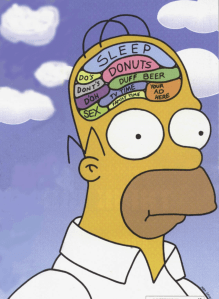 There are, of course, the times when my brain lets me think that things are going all right, that life is good, and that the writing I’m doing is strong. It even convinces me that just around the corner, if I hang on a little bit longer, might be fame and fortune as a world-reknown author.
In the words of Homer Simpson, Stupid brain.
Now scientists are doing some pretty awesome stuff at working out just what’s going on in there. They discovered that the funny-looking wrinkly lump of gook inside your head is actually an incredibly complex network of neurons and connections, forming literally trillions of possible pathways for electrical conductivity. Sort of like the wiring in our basement. They worked out that this little bit of the brain in the back called the cerebellum is responsible for motor control. If this bit gets damaged, you can’t really move anymore. There are some pretty nasty genetic diseases that do this.
 They also worked out how the neuronal system works (sort of). Ions pass in and out of the neuronal cells, carrying charge with them. When the charge reaches a joining point, it makes the cell spit out a whole host of chemicals so that the next cell can pick them up. These chemicals, or “neurotransmitters” (big air quotes), kind of make sure signals go where they’re supposed to. Sometimes the insulation on these neurons breaks down, and the charge sort of leaks out. This means not as much gets to the next cell, and all sorts of things go wrong. Multiple sclerosis does this.
Stupid multiple sclerosis.
And sometimes, the brain just messes up completely, and spits out too much neurotransmitter, or not enough, or the wrong damn kind. Now, figuring out why this happens is still being worked on. Ironically, some of the drugs that are supposed to help with this aren’t even fully understood themselves. Chlorpromazine was intended as an anesthetic in the fifties; it turned out to be more useful as an antipsychotic in schizophrenic patients.
So we’re sort of trying to figure it all out. The scientists are working on it from a chemical point of view (my wife conducts research on a particular type of chemical sensor with important roles in learning and memory); the shrinks are working on it from a cognitive point of view; the priests are working on it from a god point of view.
But in the end, my brain is still kind of messed up. It makes me do these pretty odd things, like repeating phrases over and over again, shaking when I’m upset (getting upset, a lot), feeling generally miserable and depressed, actually enjoying feeling miserable and depressed, and consistently doing things that I know are going to cause major problems down the line. I checked it out; I don’t really quite fit depression; I don’t really quite fit bipolar; I don’t really quite fit asperger’s; I don’t really quite fit schizophrenia (I have an uncle who is, though; he barks at the moon and is otherwise a lovely guy).
It could be some time before someone works out what’s going on with my brain. It could be the scientists; it could be the shrinks. It could be my wife, though I think she’d just as much rather I get rid of the damn thing entirely, and upgrade to a new one. I sort of agree – it is getting a little long in the tooth.
Until then, though, I guess I’ll just let my brain figure itself out. If it can’t, it’s no membrane off my frontal lobe.
Hey – maybe your brains can help! What do you think my brain is up to?
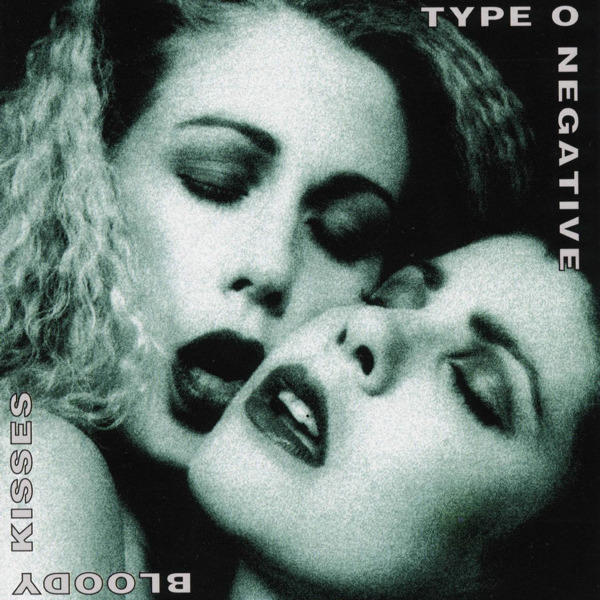

I spent most of my youth as a Goth (with a capital G), and for those of you who remember that time (or those of you who are still there), the music you listened to more or less defined who you were. In many of my hopeless and black moods, of course, there was nowhere to turn to than the wonderful misery of My Dying Bride, or the gloom-laden ballads of Sentenced. For the anger and fury, there was nothing else but Metallica and Slayer. When it was time to absolutely, once and for all I’m-really-doing-it-this-time slit my wrists, it could only be Marilyn Manson.
But, among all of these, there was one band that defined Goth more than any other I could think of, and this was the music I turned to when I simply wanted to dress in black, don the crosses and the black eyeliner, and sit moping in the back of a pub, pitying the fools who thought they were having a good time. That band was, of course, Type O Negative.
Type O Negative had a long and painful birth. As far back as 1976, four kids from Brooklyn were already gathering together in basements and garages, throwing together punk covers and goth rock. Like any young band, they went through endless lineup changes, finishing off in the eights with basically the same members as they had started out with. However, it took until nearly 1990 for their subversive music to be noticed, and their debut, Slow Deep and Hard to be released.
Ever mocking in their misery, Slow Deep and Hard featured extremely long, totally un-radio-friendly heavy metal doom, with bizarre (yet ultimately comprehensible) titles such as Unsuccessfully Coping with the Natural Beauty of Infidelity, a rather graphic song about being cheated on, to Gravitational Constant: G = 6.67 × 10^8 cm^-3 gm^-1 sec^-2, about suicide. While popular, it wasn’t until 1993 that the band truly broke through with Bloody Kisses.
A gothic masterpiece, Bloody Kisses is ultimately most famous for the title song, and the miserably humorous Black No. 1 (Little Miss Scare-All). The album extends for a full 73 minutes, passing from dark religious cynicism on Christian Woman to the bizarrely drudging cover of Seals and Crofts’ Summer Breeze, to genuine, suicidal misery on Bloody Kisses (A Death in the Family).
In hindsight (hind-hearing?), every song on this album is excellent, including the disturbing interludes such as Fay Wray Come Out and Play and Dark Side of the Womb, but at the time, the songs that truly spoke to me were those drenched in gloom and blackness. Black No. 1, so titled after the popular hair dye, references everything stereotypically goth from vampires to Halloween to the Munsters, and even a nod to Ministry‘s 1984 hit, Every Day is Halloween. Christian Woman, with its rather explicit lyrics of religious control and sexual repression, spoke deeply to the sexually-desperate teenage boy in me.
The one song, however, that truly got to me, that empathized with my own misery and formed the soundtrack for the trips to the darkest places in my mind, was the title track, Bloody Kisses. A depressingly morose song about a girlfriend who had committed suicide, it speaks of the strength it takes to kill oneself, the misery of being left behind, and challenges the dogma regarding suicide as a cry for help, or for attention. Surrounded by darkness, hopelessly depressed, and hopelessly attracted to a girl who was just as hopelessly depressed as I was, the lyrics spoke my own thoughts through the song.
A pair of souls become undone
Where were two now one
Divided by this wall of death
I soon will join you yet
With my blood I’ll find your love
You found the strength to end you life
As you did so shall I
Though my mind is (sometimes) in a better place now, this song continues to hold a special place in my heart, as a reminder of just how dark the world can be. Type O Negative continue to be a favorite band of mine, and their music of darkness and depression are all the more poignant now – Peter Steele, founding member and singer, died in 2010 from heart failure, at the peak of his abilities. He was only forty-eight years old. Needless to say, there will be no further Type O Negative, but the seven albums they left us are a memory unto themselves – a biography of the misery, depression and black humor of the man who created them.
 Satis Writes