Thought of the Week: Crowdsourcing of the Best Kind

April Jones, from Machynlleth in Wales; five years old, and missing.

About a week or so ago, I learned that a young girl named April Jones was abducted from a small village in central Wales. I don’t follow news, for various reasons, so it’s surprising that I would have learned about something like this at all.

The truth is, I learned about it from Facebook. I wasn’t even particularly on the lookout for anything like this; one of my friends shared the post.

At first, I wasn’t quite sure what I was looking at. Then, I wondered even more, given that I don’t live in the United Kingdom any longer. Though possible, I thought it was pretty unlikely that I’d come across a kidnapped Welsh girl in northern New Jersey. It then occurred to me, however, that though I didn’t live there anymore, a large number of my Facebook friends do.

There are great, raging debates about the concept of crowdsourcing lately. It’s funny, because it isn’t really anything new. In 1857, a call was made to the denizens of the United Kingdom to submit words they knew from their own usage and dialects to a ground of people in London, for the sake of cataloguing the entirety of the English language. Over the following seventy years, nearly six million individuals submitted their words, and in 1928, a ten-volume dictionary was unleashed upon the world. It’s called the Oxford English Dictionary.

This was incredibly innovative, and a lot less work for the folk in charge, who presumable would otherwise have had to read the complete works of Shakespeare instead. I imagine few, if any, of them lived to see the completion of their work, but I think they’d be proud to know that their work has endured as one of the defining catalogues of the English language to this day.

In more modern times, crowdsourcing has been used in a variety of other ways, and it is the advent of the internet, and the massive, global connections it entails, that have helped it become so powerful. In the past, if you wanted to know how much people liked your shampoo, you’d have to take a sample of opinions from a small collection of people (1,000 would be doing well), and extrapolate from there. Sometimes it worked well; sometimes it didn’t. Medications have been released upon the market, only to show severe and dangerous side-effects that hadn’t been anticipated. A larger sample size might have helped.

But now, it’s entirely possible to set up a website, and ask users of your product to go online and review it. This happens with online shopping companies all the time. In most cases, people don’t have a problem with this, because they’re in control of the information they provide.

However, the fears that have arisen lately seem to stem from the information that is gathered without direct input from the end user. People were infuriated to learn that their location might be tracked by a giant company without their permission. Or even with their permission; it honestly doesn’t seem to matter. People are shocked to discover that search engines track their searches, search patterns and even verbiage in their queries. Many see it as an invasion of their privacy.

In my line of work, I often have people asking me why my company insists on knowing where they are. I usually point out that I already know where they are.

The thing is, the more people get themselves worked up about what information is being collected about them, the less they think about the implications of it. The very nature of crowdsourcing is that the useful information is not in the individual, but the patterns of thousands and millions of people combined. A search engine couldn’t care less what you search for; their only interest is in what eighteen million people search for at 9:16 AM. And then what they search for at 10:02 AM.

The irony is that people often don’t even recognize when their location is being used. Anyone who’s used a satellite navigation system is having their location tracked. It’s how they can tell you when there’s traffic ahead, but seeing that a hundred other users of the same device haven’t moved for the past fifteen minutes. There’s nothing magical in it. It’s how a search engine knows to offers suggestions when you search for puss, but not if you add an extra letter.

Yes — crowdsourcing has implications of privacy. There is a measure of trust that we have to place in the people tracking our information not to abuse that power. A surprising example of this is a search engine offering different advertisements when you search on your home computer than when you search on the computer at the library. Wow — they know where you are.

Um, yes, they do. Big surprise.

But ultimately (and so far), I’ve yet to come across any examples where crowdsourcing has been used to the detriment of a large population of people. Many of the luxuries we take for granted, such as shopping recommendations and movie trailers, are possible because of crowdsourcing.

And of course, every once in a while, it can be used to educate over a billion people across the world that a little girl in Wales has gone missing. And there’s a good chance, if she’s still alive, that someone who’s seen her face on Facebook might see her face in real life, too. It’s increasingly likely she may no longer be alive, but I urge you nonetheless to go to the Facebook page set up for this, and click Share. I’m sure her parents will appreciate it.

Thought of the Week: Pandemonious Pumpkin Juice, Batman – I’ve Been Freshly Pressed!

Wow! It finally happened! Though in truth I never actually expected it.

Out of the blue last week, I got an email from WordPress telling me that one of my posts had been chosen to be featured on Freshly Pressed. I pretty much thought it was a hoax.

And since for a few days nothing seemed to happen, I started dismissing it. Though I was secretly kind of nervous.

But then, on Saturday morning, I woke up to find I had three hundred hits. Three hundred. My typical number per day is about two.

Naturally, I rushed over to Freshly Pressed, and sure enough, there at the top of the page was my post! It was like, super wow!

That Saturday, I got 885 hits. In June, for the entire month, I got 775.

Off the back of this one Freshly Pressed article, I got 100 comments, 72 new followers, countless likes, and met some new fellow bloggers that I would likely never have come across otherwise.

So I have two simple, enormous thanks to give.

  1. Thank you to WordPress for featuring my article. I was honored by your faith in my writing, and the consideration that other people would enjoy it.
  2. Thank you even more to every single person who stopped by, read, liked, commented and followed me. I am simply blown away by the support, the kindness, the thoughtful comments, and most of all the sheer number of you that have enjoyed what I had to say. Thank you, thank you so much!

And that’s really all I have to say this week. You are incredible – every single one of you!

Thought of the Week: What’s Going on in There?

I have a confession to make. It’s kind of a big deal, and it’s taking me a lot of courage to share this with you all, so please don’t laugh. Are you ready? Here goes:

I may not, in fact, be entirely sane.

What’s that? You already knew? How insulting.

Okay, fair enough. Most of us are pretty whacked out at times, and sanity is in the eye of the psychologist. Although I kind of think they’re nuts too.

Who does a therapist go to for therapy? Is there some kind of super-therapist? Maybe Batman goes to see him.

Anyway, it occurred to me quite some time ago that my brain is up to no good, and I’m the one stuck with the consequences. For example, sometimes my brain tells me that my life is not worth living, that I’ve brought nothing but pain and misery on everyone around me, and that they’d all be better off if I didn’t even exist.

Anyone else ever have those thoughts? Congratulations, you’re insane too.

Other times, my brain tells me that it’s a good idea to lie down on the floor in a ball while my wife screams at me to stop lying on the floor in a ball. It seems to think that she’s using some kind of reverse psychology, and in fact wants me to stay down there. Just to make sure, my brain won’t let me move for several hours afterwards. If I try, it makes my tummy feel bad.

Takers, anyone? Maybe you’re slightly saner than you thought.

There are, of course, the times when my brain lets me think that things are going all right, that life is good, and that the writing I’m doing is strong. It even convinces me that just around the corner, if I hang on a little bit longer, might be fame and fortune as a world-reknown author.

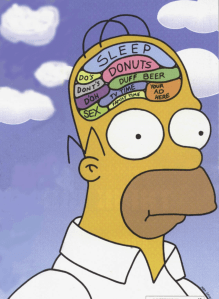
In the words of Homer Simpson, Stupid brain.

Now scientists are doing some pretty awesome stuff at working out just what’s going on in there. They discovered that the funny-looking wrinkly lump of gook inside your head is actually an incredibly complex network of neurons and connections, forming literally trillions of possible pathways for electrical conductivity. Sort of like the wiring in our basement. They worked out that this little bit of the brain in the back called the cerebellum is responsible for motor control. If this bit gets damaged, you can’t really move anymore. There are some pretty nasty genetic diseases that do this.

They also worked out how the neuronal system works (sort of). Ions pass in and out of the neuronal cells, carrying charge with them. When the charge reaches a joining point, it makes the cell spit out a whole host of chemicals so that the next cell can pick them up. These chemicals, or “neurotransmitters” (big air quotes), kind of make sure signals go where they’re supposed to. Sometimes the insulation on these neurons breaks down, and the charge sort of leaks out. This means not as much gets to the next cell, and all sorts of things go wrong. Multiple sclerosis does this.

Stupid multiple sclerosis.

And sometimes, the brain just messes up completely, and spits out too much neurotransmitter, or not enough, or the wrong damn kind. Now, figuring out why this happens is still being worked on. Ironically, some of the drugs that are supposed to help with this aren’t even fully understood themselves. Chlorpromazine was intended as an anesthetic in the fifties; it turned out to be more useful as an antipsychotic in schizophrenic patients.

So we’re sort of trying to figure it all out. The scientists are working on it from a chemical point of view (my wife conducts research on a particular type of chemical sensor with important roles in learning and memory); the shrinks are working on it from a cognitive point of view; the priests are working on it from a god point of view.

But in the end, my brain is still kind of messed up. It makes me do these pretty odd things, like repeating phrases over and over again, shaking when I’m upset (getting upset, a lot), feeling generally miserable and depressed, actually enjoying feeling miserable and depressed, and consistently doing things that I know are going to cause major problems down the line. I checked it out; I don’t really quite fit depression; I don’t really quite fit bipolar; I don’t really quite fit asperger’s; I don’t really quite fit schizophrenia (I have an uncle who is, though; he barks at the moon and is otherwise a lovely guy).

It could be some time before someone works out what’s going on with my brain. It could be the scientists; it could be the shrinks. It could be my wife, though I think she’d just as much rather I get rid of the damn thing entirely, and upgrade to a new one. I sort of agree – it is getting a little long in the tooth.

Until then, though, I guess I’ll just let my brain figure itself out. If it can’t, it’s no membrane off my frontal lobe.

Hey – maybe your brains can help! What do you think my brain is up to?