Tales of Despair: The Color and the Key of Despair

What mood do you see?

There are certain things that ring so of despair that they are instantly recognizable. In life there are such things — death, sadness, old men crying. In art also, there exists an equal dogma of darkness (even the term darkness serves as such an example). The darker of colors — black, blue, crimson — these are colors of despair. They are the colors of things that are frightening — the black of night, the unfathomable depths of the ocean, the terrifying heat of flame, and the letting of blood.

These colors form a great part of our perception of misery and sadness. Winston Churchill famously referred to depression as his “black dog”. Yet even the shading of these colors is significant; when we describe someone as being “blue”, we rarely imagine the pale, soothing blue of a spring sky. Bright red is a color of excitement and joy; deeper tones convey heat and flame and blood.

I think this man might be useful to me – if my black dog returns. He seems quite away from me now – it is such a relief. All the colours come back into the picture.

— Winston Churchill, 1911

And these tones are carried through into music. Ignoring synesthesia, it isn’t uncommon to think of a song or piece as carrying a particular color. These visual representations of key vary from person to person; if you were to ask any two musicians, you would likely get two completely different descriptions.
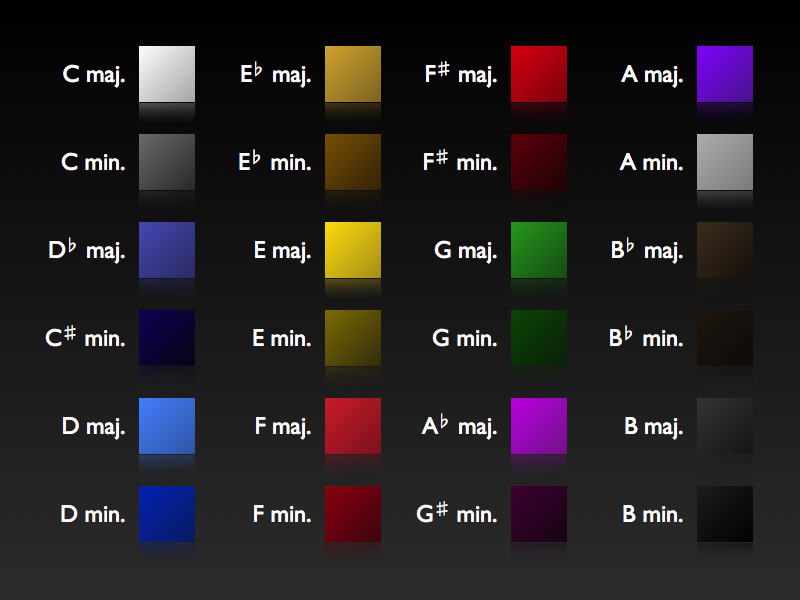
My personal key-color relationships. Even ignoring the colors, notice that the minor keys are universally darker than the major ones.

Having said that, there are certain keys that, almost universally represent sadness, anger and despair. As a starting point, these keys are naturally minor. The bright, exuberant major keys — the clean, purity of C major or the homeliness and warmth of E-flat major — rarely suggest any aspect of darkness. The inherent sad quality of the minor key, however, is inextricable.

The falling of tears.

Part of this is in the psychological impact of the falling semitone; to turn major into minor, the third key of the scale falls by one semitone. The very nature of falling and descent is linked to death (going underground) and sadness (the falling of tears). One of the most heart-wrenching progressions is the fall from the sixth note of a minor scale to the fifth (especially if the root note remains in the bass). A wonderful example of this is the opening of Sotto Vento by Ludovico Einaudi.

However, quite apart from this inherent quality of the minor keys, there is a particular key (or closely related keys) that has throughout the history of western music been used to express the deepest pathos and despair. Countless works have been based on this key, and they are without exception some of the most beautiful, and tragic, pieces of music ever written.

I speak, of course, of B minor (the key that, for me, is represented by the deepest black). There is likely a reason for this; C major, the standard and most oft used key, is above this by one semitone. The shift, the fall from this key of happiness, represents a profound shift from light to dark.

Violin part from the first edition of Beethoven’s fifth symphony.

What’s interesting, however, is that this history of this key is not so straightforward. Though from the 1800s onwards B minor because a de facto standard for sadness, it was prior to this rarely used. Instead, the tonally slightly higher key of C minor was used instead. Mozart wrote a beautiful mass in C minor (despite rarely using minor keys in general); one of his best piano concertos is the twenty-fourth in C minor. Later, Beethoven used this key for one of the most famous and furious of compositions: the raging fifth symphony in C minor. He was attracted to this key several times further: his eighth piano sonata, the Pathétique; the third piano concerto (clearly and heavily influenced by Mozart’s own piano concerto in the same key), and the thirty-second piano sonata (one of the last pieces he ever wrote).

The tragedy of Swan Lake.

Yet something happened in the early nineteenth century that changed this, and suddenly the key of despair dropped a semitone. We began to see works such as Schubert‘s eighth symphony, Chopin‘s third piano sonata, Liszt’s only piano sonata and the wonderful Totentanz, and Brahms’ chamber works (one of the most delicate and beautiful, the first piano trio in B, is in fact half in B minor). And then there was Tchaikovsky. B minor was an epic favorite of this troubled composer, being the home key of his first piano concerto, the beautiful Swan Lake, the furious passages of the Romeo and Juliet Fantasy Overture, and of course the intensely tragic and heartbreaking sixth symphony, the Pathétique.

Though at first it might appear that there are therefore two keys of darkness, and that the choice of key is down to the individual perception of the composer, it turns out not to be so simple. In the eighteenth and nineteenth centuries, there was no set tonal standard, meaning that different countries, and indeed different orchestras, would have their own definitions of standard concert tonality. In most cases, of course, the tonalities were similar – often differing by one semitone.

And to this day, as western tonalities became standardized (a practice that was only formalized in the 1950s), the key of B minor has assumed reign as the common standard for darkness, and despair.

Tales of Despair: Oh, For the Dark World

The Days of Light

Once, there was a world filled with light, and love.

There was a home, whole and fine, even if it changed into different homes over the years. The home was warm in the winter and had a fire, and was cool in the summer with open windows. There were woods to explore, bikes to ride and paths to follow. There were bright toys, shades of color and paper to take them, and a pen to write down the adventures of the mind.

There were walks in the forest, great trees towering monumentally overhead, cascades pouring down through the green glens. There were great treks of many days across the mountains, soaring peaks and biting rock and shivering snow, a tent pitched by a crystal alpine lake, and the wonder of a map as it led down twisting and winding roads.

There were friends who would come to birthdays, who would bike to school and who would go rock climbing on Fridays. There were beloved teachers and caring parents, if a little overbearing. They encouraged and fostered, gave love and grew confidence. There was music, and there was writing, and there was the soar of the imagination. There was a full life, and there was joy.


The Days of Dark

And then, one day, the light and love disappeared.

The home became a prison, one that changed into other prisons over the years. The windows remained shut, and the shades were drawn. The fire became candles, lit only in the depths of the night, in a room all alone, the door locked. The woods were forgotten, the bikes gathering cobwebs. All the colors turned to black, and the toys…they turned to razors.

The trees appeared gnarled and twisted, even in the midst of summer; their towering heights now oppressed, threatening to crush and choke from above. The mountains became evil, and a jailer, a torment that prevented the comfort of a bed in a corner in the dark. The world was dim, and the sun failed to pierce both eyelid and heart.

The old friends left; new friends came, and shared the blackness of the world. They would drive to school with doom on the radio, and would go drinking on Fridays. The teachers and parents looked with sadness and despair, and all their encouragement fell on deaf ears, their love on a broken soul. There was no confidence, no hope, and the imagination saw only the ending of all life. There was an empty life, and there was misery.


The Days of Gray

And so life went on, for many years. There was no going back, no return to the days of light. The nature of the darkness changed as the homes once did, but always against a background of blackest black. There were days when life was bearable, and days when rising from bed was more effort than there was to spare.

But there was one, a single person who refused to give up. One who would not accept the lethargy, who refused to allow the darkness to thrive. She fought, and for her efforts received anger, and abuse. But in the face of this was an indomitable will, a knowledge that, free of the pits of despair, there was a soul worth saving.

And there was a child. A precious, tiny child who did’t — who couldn’t — understand the darkness. A child who did not deserve to be subjected to its despair. And that broken soul, it saw the child, and for the first time in forgotten years, knew that here was a thing to live for. The survival of this infant life was, if nothing else, the sole reason to begin to fight the darkness.

The battle is far from won. There have been great triumphs, and even greater falls. Wonderful joy when the child shows thoughtfulness and caring, and the deepest guilt and shame when it displays the same rage and obstinacy of its father. And what makes it all the harder is that, in the face of inarguable proof that the darkness must be abandoned, that broken, stained soul still longs for it with a great, empty ache. The darkness lived for too long, and is now an inseparable part of life, no easier parted with than one’s own finger.

But the struggle will continue, and it will continue because of that one, single person, and the child she gave him.


I love you, sweetie.

Satis 2012

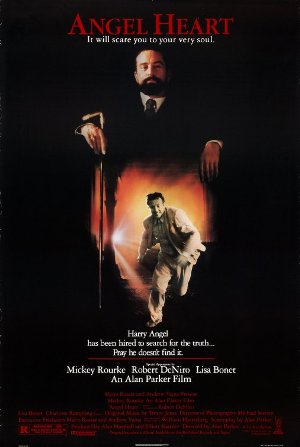
Tales of Despair: Angel Heart

Post-war, times are tough. His clients are few, and those few are poor. His investigations rarely amount to much.

The suave and sinister gentleman who hires him, however, pays well. Cash, some in advance – irresistible. It’s simple enough; a pre-war big band singer had a contract with the gentleman, but suffered brain damage during the war. The hospital says he disappeared – conveniently preventing the contract from being fulfilled. Find the singer – simple enough.

And then the singer’s doctor blows his brains out. Too much – murder isn’t down his alley.

Five thousand dollars changes that. He keeps going, keeps asking questions. Following those who knew the singer, he ends up in New Orleans, desperate to track the man down. And as he goes, further people end up dead. Could the singer be killing his former friends, to prevent himself from being discovered?

Eventually, the private eye uncovers a terrible truth – the singer, a voodoo heretic, had made a deal with the devil in exchange for fame. His wartime injuries lost him his stardom, but also prevented the devil from collecting on the deal.

Unwilling to believe this insanity, he seeks out the woman who was once the singer’s lover – to find her dead. Panicking, he searches her room, desperate to find any evidence – and comes upon a dog tag…with his own name upon it.

Reeling, he returns to the gentleman, hoping to find understanding. And understanding he gets – he was the singer, and now remembering, the gentleman – the devil – is free to cash in on the deal. A girl is found murdered in his own apartment; he is arrested; he is to be executed.

And when he dies, he descends, into the basements of hell.

Angel Heart (1987) is a masterpiece of darkness, a tale of insanity, of panic, and of evil. Set against the background of 1950s New York and New Orleans, Alan Parker’s genial directing paints an intensely moody and grim atmosphere, wholly dragging the viewer into the slow descent into madness as we follow Harry Angel on his circuitous – and ultimately fruitless – investigation of himself.

Mickey Rourke – pre-bashed-up boxer Mickey Rourke – is phenomenal, entirely convincing as the amnesiac private investigator; hard, sure and competent, the nature of his character at the start of the film only serves to contrast all the more with the power the devil has to drive any man to madness. And Robert DeNiro, though appearing essentially as a supporting role, is perfect: no one else could play the devil as he does.

Angel Heart is a movie of despair and depression; there is no happy ending, no get-out clause or last-minute rescue. Harry Angel is drawn into a sordid world of voodoo, murder and conspiracy, only to find that it was the world he left and forgot in the first place. It is gripping and graphic, and well-worth the watch. Just don’t expect to be happy at the end of it.