Tales of Despair: The Triumph of Death

I am no student of art, and I know little of the medium and its history. However, I came across this painting some years ago, and even to my untrained eye it is exceptional for its time.

Pieter Bruegel (1525 – 1569) was a Flemish painter at the height of the Renaissance, when secular art began to be accepted in European culture, and people suddenly started painting people and fish, and not just god. Bruegel in particular has become renown for his paintings of everyday life, depicting peasants, hunters and even beggars, working hard to capture the scenes all around him (a kind of 16th-century George Bellows). In many of his works, however, he allowed fantasy to creep into the scenes, such as Landscape with the Fall of Icarus.

Detail showing a king, all his riches powerless to slow the advance of time, and the coming of his death.

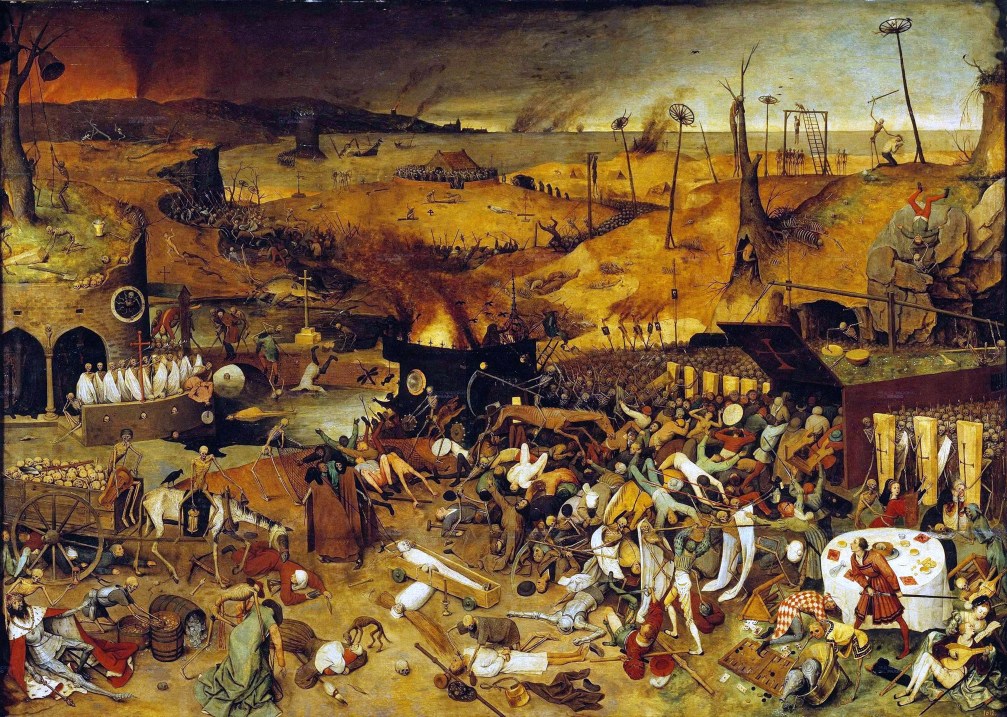
Still, none of his paintings (including Dull Gret) come nearly as close to the dark and twisted nature of The Triumph of Death. This is a massive work – the original is some five feet across – and it portrays hundreds of figures, fallen upon by an army of death. There is too much here to even begin to go into, so complex is the entire painting, but there are some points within it that genuinely stand out to me.

Overall, it seems painting seems to emphasize death as the lord of all – kings and peasants as one fall victim to its clutches. In one corner, a great king, cape in ruins, cannot prevent a grinning skeleton from pillaging his gold. As a reminder of his despair, a second skeleton holds up an hourglass, driving home the fact that he will not long last in this world.

Detail showing a man and woman playing music, unaware of death mocking them behind; a moment of black humor in an otherwise bleak work.

The detail of the agony and despair in this painting is astonishing, and excruciating; every inch of canvas is covered by death. Even where there are people yet alive, death is yet hounding them. In one small detail, a man, stripped and naked, seeks refuge from the horror by hiding under the roots of a tree. It is, of course, futile – a spear protrudes from his back. In another, a man fleeing desperately, is set upon by the starved hounds of hell, while a skeleton looks on nonchalantly, waiting as they take down their prey. In particular, though, I am drawn to a small detail that shows two people – perhaps the only people in the entire painting – who seem unaware, or unaffected, by the death and torture around them. The man is playing a lute; the woman is singing from a songbook with him. The man looks worried, as though he perhaps should be thinking about something other than their music, but the woman rests a reassuring hand on his shoulder, and carries a calming expression, as though music is untouchable by death. In an inspired moment of irony, Bruegel adds a skeleton, hiding behind them, accompanying them both on the fiddle.

Church – and god – are no escape for the coming of death.

Though the Renaissance was, of course, a time of artistic awakening, religion was nonetheless and inescapable and fundamental part of culture, and every person’s life. Prayer, and the hope of an afterlife, was often the only consolation for peasants who slaved for a lord, starved, and grew ill with terrible disease. For Bruegel, however, even the church is unable to give deliverance from death; in what may have been nearly heretical at the time, he depicts the skeleton army invading the house of god, desecrating its windows, drowning people in its river, and mockingly calling the ring of silver trumpets. To the right, a very large portion of the canvas is given to showing the skeletons herding people in droves into a cross-embossed box, while their armies await on either side, holding shields bearing crucifixes. It is as though Bruegel was verily denouncing religion itself as false hope of life.

The scene is a grim twist on the artist’s nature and style. Whilst many of his works depict ordinary scenes of peasant life, here he takes a scene from almost every class imaginable, and treats them to the same horror and finality. The princes and the poor, the pious and the sinners, all succumb alike. In the distance, the fires of hell glow bright, while skeletons ring a great funeral bell. Ships burn on the horizon, and the earth is barren of all growth. The only life that seems to persist are the crows, likened as always to companions of death.

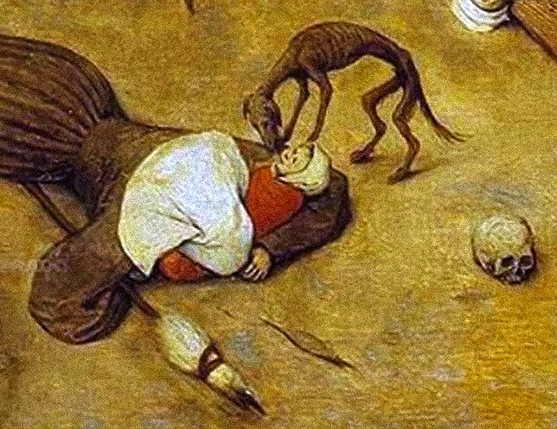
In Bruegel’s eye, death spares no one, and nothing. By the river, a large whale or dolphin lies butchered, and in the distance, skeletons hack at the few remaining trees. However, the true depth of the artist’s horror, and the epitome of death’s cruelty, is in a small detail at the bottom of the painting. Prostrate, a mother lies dying, her bundled infant dead in her arms. The true ghastliness of this scene, though, and the terrible truth of death, is the skeletal hound of hell, feasting on the dead child’s flesh.
Tales of Despair: Werewolves in Suburbia

This is a tale of depression, misanthropy and suicide. Of coming of age, and of dying. It speaks of the banality of modern society, and the terrible havoc of a demon from long ago.

In a basement, two sisters live. In the dim light, they dream of their escape, by flight or by death. In the waking world, they are disliked by all; in the dungeon of their home, their dislike is only for themselves, and for life. Though their parents live above them, they have little contact with them, and the disconnect between their lives is total.

And then, the eldest sister is mauled by the beast. They know not what the beast is, nor its provenance, but the girl’s transformation becomes slowly unmistakable. The physical is preceded by the mental and the emotional, and she turns upon her own sister, ostracizing her in favor of encounters that satisfy her newfound and ravenous sexuality, and her equally ravenous and terrible appetite.

Refusing to leave her sister to her fate, the younger girl pursues her, even as she starts down an irreversible path of death and destruction, beginning with the devouring of pets, and leading to the murder of a local girl. In a rare lucid state, the elder sister helps her sister bury the dead girl, but the realization comes to the younger one’s mind that her sister is not the person she once knew: she would eat the dead girl, given the chance.

Desperate to redeem her sister, her only soulmate, the younger sister discovers a possible cure – but it is too late. Despite barring her in their shared bathroom, her transformation has become too great, and she escapes, leading her to their school. Frantic, the younger sister follows her, encounters her as she seduces a boy, the only one who believes the truth of her transformation. In pain and torment, they subdue her, and drag her to their home, where the last dregs of their cure remains. But it is too late – her transformation is complete. Now a beast herself, the boy is murdered before her eyes, yet her devotion to her sister, terror through she now is, is resolute: she will cure her, or release her from her pain.

And in the end, of course, the cure is forsaken, and the girl, weeping, is left with no choice, and plunges the knife deep into her sister’s heart, listening to the beast’s slow and ragged breathing until, finally, it ceases.

Go watch Ginger Snaps.

Tales of Despair: Standing on the Edge, and Daring to Jump

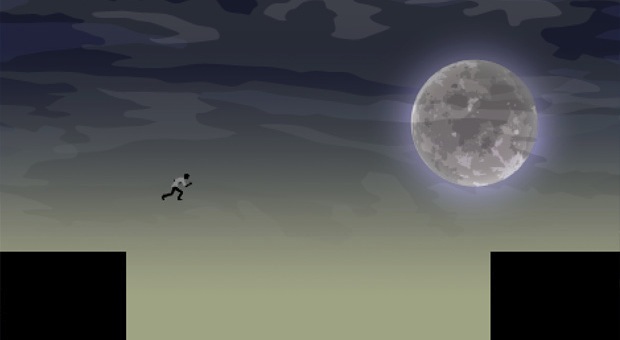
There is a game I played on my iPhone. It’s called One Single Life and I didn’t play it again. The game’s concept is very simple: you run, you jump, and you land on the next building. There is just one catch: if you die, you die. You do not get a second chance. This is one of the most thrilling games I have ever played; the knowledge that my quarter-inch avatar is about to leap quite possibly to his tiny death sends tremors to my fingers. My heart beats fast, and my palms are as dry as dust. I am terrified.

I know this sensation well, and it is the pause before the leap. In my youth, I spent a great deal of my time rock climbing, mostly at indoor rock gyms since the weather was usually bad. Some of the long routes were scary; one curved wholly over the ceiling of the gym, some sixty or seventy feet off the ground. Still, there was always a sense of safety, of a second life: the floor was cushioned, you were roped in, your climbing buddy had you.

But there was a time when a friend and I went walking in the Swiss Alps. I say walking, but we were young and foolish, and couldn’t resist the temptation to race each other up small cliffs here or there, quite proud of our budding climbing skills. This naturally delayed us, and we found ourselves quite late in the day still on a glacier, not even close to where we needed to be, and so decided quite wisely to take a shortcut over a low peak to the north. The peak had looked innocent enough on the map, but when we arrived at its base, we realized we were faced with a hundred-foot cliff face that was not quite vertical…and of course we just had to climb it. After all, it would surely be faster than going around.

I won’t speak of the abandoned Swiss military base at the top of this mountain – that is for another time – but it was halfway up this ridiculously foolish ascent that I first truly realized that I could die. Despite my confidence, the rock was loose, and in grasping for a handhold, the stone simply came free in my hand. For a single, endless moment, I wheeled slowly, sickeningly away from the cliff, releasing the rock and knowing it might hit my friend below me, and all the while grasping in utter desperation at the cliff with the two remaining fingers that attached me to it. Somehow – I have no memory of it to this day – I did not release my grip from the wall. I believe I was in tears when we finally arrived at the top.

The free fall in the stomach, the dryness of hands, the hypersensitivity to every touch and sound, are the hallmarks of standing on the edge of death. Sadly, my experience in the Alps was not the only time this sensation came over me. Countless times since then, I have found myself on that edge, often with a blade to my wrist. I have lived with people who have stood on that edge with me, and we would stare into the darkness together. The sensation, as the steel bites into your skin, or the rope rubs roughly on your neck, is not of pain, or of comfort, or even of anguish: it is the dusty, gliding feeling of standing right on that edge, toes over the abyss, and deciding to leap.

In the end, I never leapt. Some I know did, but were caught, and survived. Some leapt and we never saw them again. I could never overcome the sensation, the thrill of death that had saved me that day in the Alps, and fell back from the edge each time. I was crushed, dismayed, guilty and furious, and all this would collapse into the deadness that I was doomed to live for yet another day; but I was nonetheless alive.

This was all some time ago, and though I still see the edge each day, I keep my distance. I wouldn’t want to fall off by mistake. I can’t convincingly say that the fear of the leap has taught me anything, but I am glad of it, for had I jumped I would not know my wife, and I would not know our son, and the world would have been a darker place.

Still, I wonder at the thoughts of those others, at the moment they chose to make the leap. I imagine it was release – the final decision they would ever need to make was done, and there was no need to look back.