Movie Night: The Lord of the Rings – The Fellowship of the Ring (Part 1)

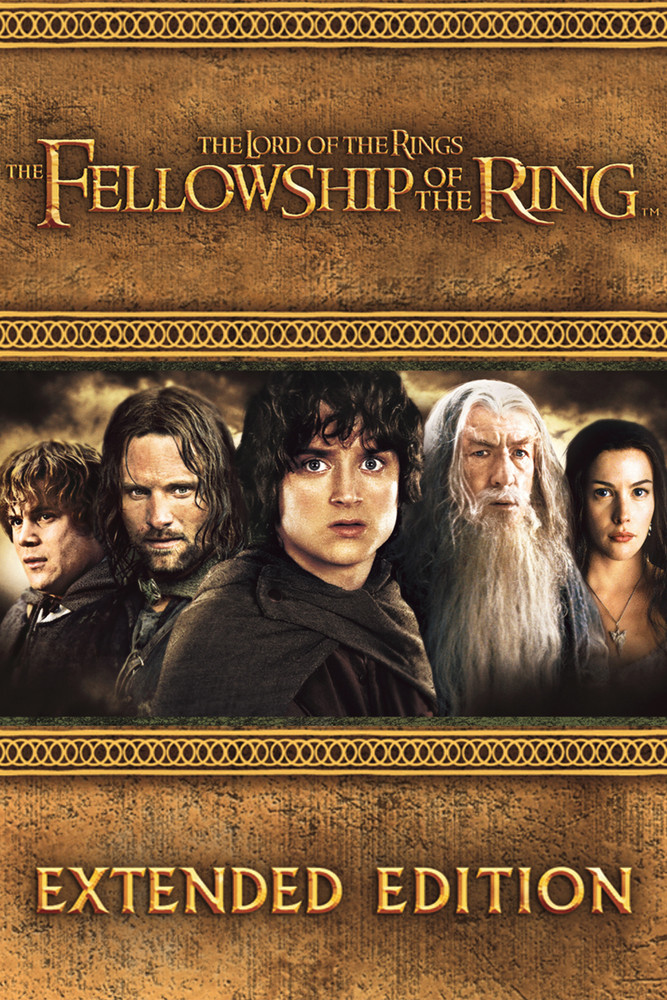
After last week’s fiasco, Little Satis and I decided we were in need of a known-good film (KGF). As we discussed it, we realized that we both had quite the hankering to revisit The Lord of the Rings.

Now as you know, this isn’t exactly a one-night endeavor, and so this will be the main focus for the next few weeks. Particularly since we are watching the extended editions (which in my mind are superior – yes they are), this is going to take us some time. Tonight, we watched The Fellowship of the Ring up to the Council of Elrond. (Fun fact – my computer’s spell-check recognizes the world Elrond.)

There’s not a lot to be said about this epic set of films that hasn’t already been discussed ad nauseum. For me, Peter Jackson’s three films represent one of the finest, most perfect filmic storytelling masterpieces of our time, alongside Ben Hur and Spartacus and Dr. Zhivago and Lawrence of Arabia (and more). I’ve discussed the music at length, and there is little more to be said about that, but there are always new things I notice in terms of the film itself.

In the area of cinematography, Peter Jackson has shown himself to be a genius. Beyond the basic settings of his native New Zealand, the direction is subtle, ingenious and masterful. Tasked with the hideous job of making a 5’6″ actor appear half the size of a 5’11” actor, Peter turned to some innovative effects. While multiple shots against green screen were used when possible, there are moments in the film when such things are simply impossible. A fantastic example of this is in the early scenes when Frodo is riding side-by-side with Gandalf in a cart; both actors – not doubles – are sitting next to each other, and the illusion is perfect. It’s only on extremely close inspection that it appears the cart was specifically built with one side of the seat further away from the camera than the other, thus placing Elijah Wood further away than Ian McKellen.

Peter’s faithfulness to the book is also commendable. I’m aware this is somewhat of a contentious issue, as there are indeed areas where Peter and his wife Fran Walsh took considerable liberties, but there are in each case a wonderfully good reason. The most common reason for changes is Hollywood dramatics; no one is interested in a character called Tom Bombadil. One of the things that impresses me continuously, however, is Peter’s respect for the pace of Tolkien’s books. The Fellowship of the Ring, like the two that follow it, is not a fast-paced film (their 4-hour running times is ample evidence of that). The fact that the opening half hour of the movie revolves around the Shire showcases this, but it serves an important job: it retains the gradual building of tension and the destroying of Frodo that is so incredibly important in the books. Take a moment and look at Frodo in the earliest moments of The Fellowship of the Ring, and compare it to the final moments before the destruction of the ring in The Return of the King. It hardly seems to be the same person.

This insidiousness is, ultimately, what draws me and Little Satis into the movie so deeply. The turning points are many, but subtle. The way Frodo looks at the ring after barely escaping the Nazgûl shows clearly that the deadly seriousness of their plight has only just dawned on him. Later, on Weathertop, the three other hobbits are cooking in the night, and only Frodo has the presence of mind to realize their fire could give them away. These are further things that change as each character experiences their own life-altering experiences.

Perhaps the most compelling scenes in the first half of this film are those at the very beginning, where Bilbo Baggins is musing on the story to write in his home under the hill. He says that a Baggins has always lived there, and always will. In these few words, we see both the beginning and the end of the tale, and are set up for all the bitterness that is to follow.

More to come next week!
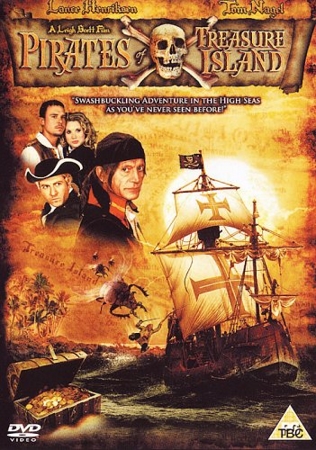
Movie Night: Pirates of Treasure Island

Year: 2006

Director: Leigh Scott

Production Company: The Asylum

Leads: Lance Henrikson, Tom Nagel

Well…it had to happen sometime. For our movie night this week, Little Satis and I picked a real stinker. I mean a complete, bogthumping rotter, in the words of Roald Dahl.

Pirates of Treasure Island is billed as a loose adaptation of Treasure Island, and loose is indeed the right term. There are similarities taken straight from the book, and oddities that appear completely out of left field, leaving you completely boggled.

In essence, Jim Hawkins (for yes, there is a Jim Hawkins) discovers Billy Bones‘ treasure map after he dies in his inn. Abruptly. He rather unconvincingly convinces his (apparent) friend Dr. Livesey to finance the voyage, and then even less unconvincingly gets Captain Smollett (French, apparently) to sail them, because he has nothing better at the moment to do. And of course, Long John Silver (I don’t even remember how he got into the tale) hires the crew.

They depart, find the island, the pirate crew mutiny, go ashore, find the treasure, duke it out with the good guys, all get killed, and everyone lives happily ever after.

Except.

The movie is full of buxom babes. Really for no reason. One of them is supposed to pass for a boy, though I didn’t actually realize it until they made a fuss out of her ‘turning out’ to be a woman. Captain Smollett (Smoyette, as he pronounces it) keeps two ‘girls’ with him in his cabin for undisclosed purposes, and Anne Bonney (played  suitably terribly by Rebekah Kochan, who – yes – starred in a movie called Lez Be Friends) is some kind of incapable barmaid who turns out to be an infamous pirate – cleavage as deep as the Marianas Trench and all –  despite being entirely incapable of handle a sword.

The treasure map was a wonderful bit of scrap paper, with a set of coordinates in the middle and nothing else. Um…I was pretty sure maps were supposed to have a little more detail than that (though actually, I suppose it is a lot more efficient that way). Oh, and it turns out it isn’t the map to the treasure at all, but a decoy; over-inflated pirate captain Anne Bonney had the real map the whole time. And just didn’t tell anyone.

The ship was an awesome piece of work – quite convincing as a nineteenth-century pirate vessel, in fact. It’s just a shame they didn’t use the same ship for the long-distance aerial shots. I mean literally a completely differently-constructed ship. It was even a different color.

Now, here’s the thing. I can overlook all of this silliness. I don’t particularly care that the swords are painted cardboard, or that the tipping and shaking of the deck looks worse than the original Star Trek, or that people just sort of fall over when they get shot. I’m willing to overlook shoddy effects for the sake of a good story. After all, look at Godzilla: wonderful stop-motion animation that doesn’t fool anyone, and isn’t disruptive at all because the story is solid. What I can’t – what I won’t – excuse is a shoddy story. Before filming begins, before casting or hiring or production or any of that other stuff happens, you need a story. And if the story sucks, it simply shouldn’t turn into a movie. I know that sadly this happens more often than not, but I’m usually able to sniff them out and avoid them like a dying stinkbug in a skunk’s rear end.

I was only attracted to this movie by Lance Henriksen. Here is an actor I deeply admire, ever since his appearance in Aliens. His performance as a disillusioned widower on the brink of insanity in the wonderful but short-lived TV series Millennium is simply perfect – stunningly brilliant, in fact – and his capabilities as an actor as transcendental. How he ended up attached to this trite is beyond me. I feel sorry for him. I don’t feel sorry for Tom Nagel or Rebekah Koch, because their resumé deserves this. They’re actors starting their career, and are meant to deliver dung on their way up (though delivering dung in dung on top of dung is probably not a particularly auspicious beginning).

More than anything, though, I feel kind of bad for subjecting Little Satis to this. He stuck through it, little trooper that he was – probably hoping it would get better – but the first thing he did as the ending credits began to roll was to screw his face up at me and go, “I didn’t really like that one.” Strike one – he’s loved every other movie I’ve introduced him to. I suppose we’re all allowed some mistakes; next week I’m making damn sure it’s an excellent movie. As for this week, I’m writing off those ninety minutes of my life as time I will never get back.

Oh, and did I mention the island was infested with giant, man-eating insects? Because all treasure islands are, I guess.

★ ☆ ☆ ☆ ☆

Movie Night(s): Lawrence of Arabia

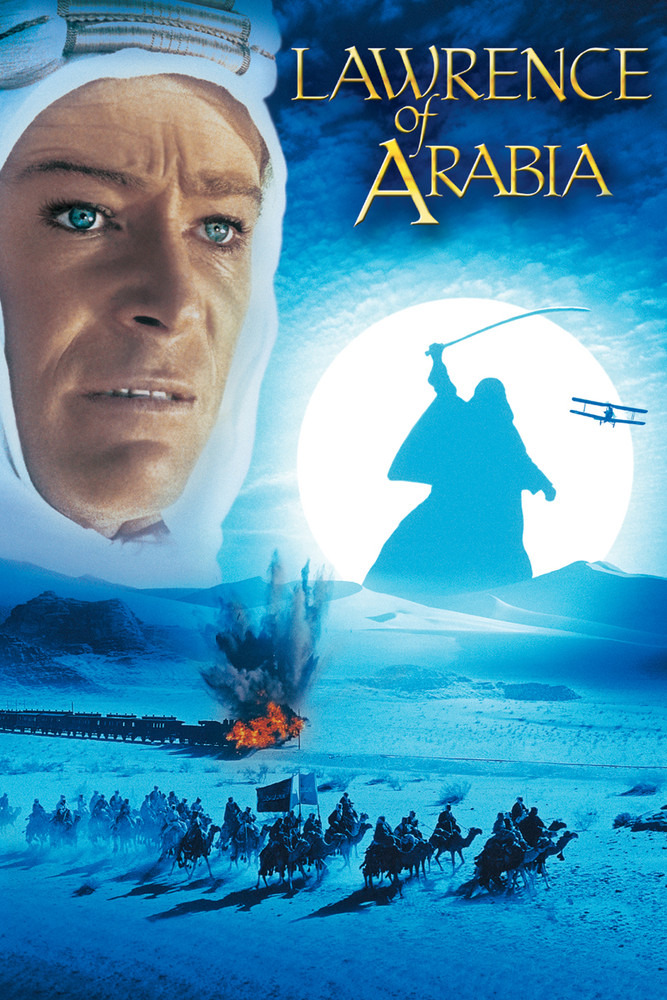
Yesterday, for one single night in anticipation of the fiftieth anniversary of its original theatrical release (December 10, 1962), select theaters across the country screened a special, digitally restored showing of the incredible, timeless epic tale of a war-torn country, and the englishman who brought about its victory.

I speak, of course, of Lawrence of Arabia. And I didn’t see it.

It was all my wife’s fault, of course. She was working late, trying to get home in time to put Little Satis to bed so I could go out by myself (oddly, no one I knew wanted to go spend four-and-half hours in a movie theater), and naturally, something came up. In the middle of experiments they were kicked out of the darkroom and not let back in again until 8:00 PM. The film had already started.

I wasn’t angry (of course); I understand how difficult and stressful her work is. But still – come on, it was a once-in-a-lifetime sort of thing! Maybe. So I did the only thing that made any sense: I trundled my way to iTunes, and bought the exact same, digitally restored, full 1080p HD four-hour-long movie. But geez, all I had to watch it on was a 40-inch television. How can that possibly compete with a 50-foot cinema screen?

Now would be a good time for some first-world-problem jokes.

The advantage, however, is that I am now able to share this incredible movie with Little Satis, who otherwise would have never had the chance to see it. We began watching it last night, continued tonight, and will (try to) finish it tomorrow. Did I mention that it’s four hours long?

I haven’t seen this movie since my childhood. My dad and I watched it over a period of several weeks on video, watching about half an hour at a time. This was a good idea. I’ve been watching it with Little Satis in stretches of an hour and a half. Not such a good idea.

Nonetheless, I’ve been impressed at how well he’s been sticking it out. He’s eight; I was about ten when I first watched it with my father. He has a reasonably good attention span, but I keep forgetting the nature of these younger generations. I was raised on a cultural diet of classical music and sixties movies, and ultimately enjoy a slow-paced movie. Lawrence of Arabia is certainly that. It’s one of those films that demands your attention, and refuses to reward you unless you listen to every word, and take in every sight. This is hard to do for an eight-year-old.

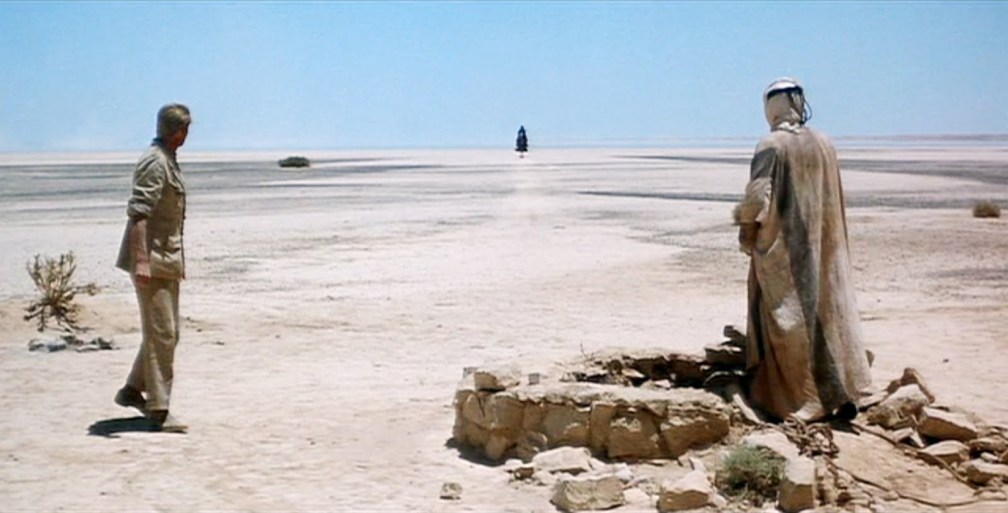
Nonetheless, he has been engaged. David Lean manages to draw up incredible suspense throughout the film, in a way that almost sneaks up on you – you don’t even realize you were on the edge of your seat until you’re allowed back down. An early scene that comes to mind is when Lawrence and his guide stop to drink at a well. A casual mention that the well is owned by a rival tribe is all it takes to set you on edge; when a speck appears on the distant horizon, you know something is going to happen. David doesn’t patronize the audience; this scene is agonizingly drawn out, as Lawrence and his guide wait, motionless, to discover who is approaching them at such a gallop, from such a distance. The shock, the final moment when the tension is released, doesn’t come until his guide is shot dead.

Lawrence and Tafas at the well, awaiting the mysterious rider.

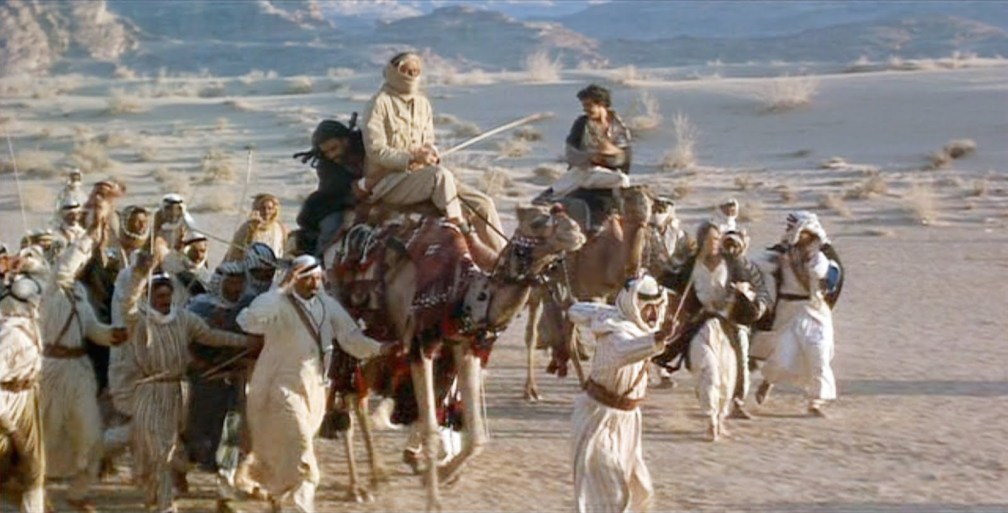
Understandably, Little Satis’ curiosity picked up when the plot began moving along. After consulting with Prince Feisal, Lawrence begins the epic journey of leading an army of just fifty men across the impassable Nefud Desert, and once again we are tortured along with the men as they pace continuously along, stopping only for a few short hours in the noon sun. At one point, one of the men falls from his camel, and is not noticed until they are off the worst part of the desert (God’s Anvil, as it’s referred to). Against the advice of Sherif, a native Bedouin, Lawrence returns to save him. This leads later to one of the most heartbreaking moments in the movie, which I will spare for those few who haven’t yet seen it.

Lawrence and Feisal’s army, emerging from the Nefud Desert.

There are, of course, elements of the film that seem dated, if not outright preposterous today. An example is that, while an enormous effort was spent in creating as vivid and realistic portrayal of Arabia as possible (and one that stands to this day), casting Alec Guinness as a Bedouin prince just does not make sense. He is a great actor, and he is fantastic in this movie, but he is not a Bedouin prince.

These few points, however, do not detract from the film, and there are moments that are so gripping and intense that they can only prove the timelessness of this film. When Lawrence finally arrives back in Cairo, having taken Aqaba and lost a good friend on the return journey, he drags his young Arab friend into the British military headquarters, insists they treat him as their equal…and finally breaks down completely. Just thinking about it gives me shivers; well done, Peter O’Toole.

One of the things to me, though, that stands out about this film (and many others of its era) is the lack of pretentiousness. The audience is expected to work for this movie. We need to listen to every word, read every facial expression, and assume nothing. I recall this from watching early James Bond movies – before they became solely about blowing stuff up. And there is delightfully poignant and witty dialogue to be had; one of my favorites is a simple little line when Lawrence talks Auda abu Tayi into fighting with them to conquer Aqaba:

Thy mother mated with a scorpion.

Equally, when Lawrence talks of the frightening implications of having killed a man, summed up in a simple, excruciatingly delivered line:

No…something else. I enjoyed it.

It would be wrong to call this a masterpiece of modern cinema; it is a masterpiece of all cinema, to be remembered as one of the most ambitious and epic films ever made. We haven’t quite finished it, but I hope that Little Satis will have got as much out of it as I did at his age by the time we are.