Movie Night: Hogfather

Year: 2006

Director: Vadim Jean

Production Company: The Mob Film Company

Leads: David Jason, Marc Warren

527-3Hard as it may be to believe, this was my first ever foray into the world of Terry Pratchett. Certainly I knew of him, and knew that his fantasy works were a rival to Tolkien in their complexity and depth, but somehow, for some reason, I just…never read them. The extent of Discworld, described throughout thirty-nine (39!) novels, frankly defies my imagination. Middle-Earth, Arda, and even my own Erâth (shameless plug, shameless plug (wait a minute; can I plug my own work in my own writing? How does that work?)) pale in comparison to the detail presented herein.

Discworld, it turns out, is in fact a flat world (I honestly did not know this when I presented Erâth as a flat world), resting on the back of four elephants, standing on the shell of a giant tortoise. I am given to wonder, of course, what keeps the tortoise entertained, and what would happen if one of the elephants sneezed, but that is pondering for another time.

Hogfather is a tale of sinister happenings at Hogswatch, which is basically Christmas except that Santa is a hog. On this particular Hogswatch, a group of rather unpleasant characters called the Auditors decide that it’s time to get rid of the Hogfather, and seek out the head of the Assassin’s Guild to commission his assassination. How exactly to assassinate an imaginary person (this got uncomfortable for me watching with Little Satis, who still believes in Father Christmas) is uncertain, but an extremely unsavory character by the name of Teatime (said Te-ah-Tim-eh), who is frankly one of the most disturbing psychopaths I’ve ever come across in fiction, giving even Hannibal Lecter a run for his money, is brought in as the killer of choice. Mr. Teatime manages to capture a tooth fairy, who leads him to the tooth fairy’s castle. Here he collects all the children’s teeth ever, and (I still don’t quite understand how) uses them for force all the children to stop believing in the Hogfather.

At the Hogfather’s absence, Death (yes, Death) takes over his job, understanding the importance of children continuing to believe. The sight of Death delivering presents is delicious, of course. Meanwhile, Death’s granddaughter Susan chases after Mr. Teatime, defeats him, and restores the Hogfather to Discworld at the very last moment.

Marc Warren as Mr. Teatime

Marc Warren as Mr. Teatime

The story (as told by the film) was confusing and disjointed, which is something that can often happen when a complex novel is adapted to the screen (see The Lord of the Rings), but this actually didn’t detract, but rather added, to the sense of darkness and confusion of the story itself. The production, for a TV miniseries, was phenomenal, from the CGI to the sets and costumes to the direction itself. The acting was of course first-rate, given that David Jason, David Warner and Tony Robinson were involved; however, it was the utterly terrifying performance by Marc Warren that really stole the show.

I really ought to have known Marc Warren better, given his high-profile career in British television, but I’m certainly going to keeping an eye out for him in the future. His embodiment of an untainted, childlike insanity is so real that I was frightened merely watching him.  The tone of innocent curiosity Warren puts into his voice clashes so violently with the words and actions of this psychopath has the effect of knotting the stomach on sight – you can’t tell if he’s going to laugh, or laugh and kill you.

I was hoping this would be good, but I was taken aback: it is one of the most astonishing pieces of film work I’ve seen for television, and it will certainly be added to the canon of festive films in our household.
★ ★ ★ ★

Movie Night: Project A

Year: 1983

Director: Jackie Chan

Production Company: Authority Films

Leads: Jackie Chan, Sammo Hung Kam-Bo

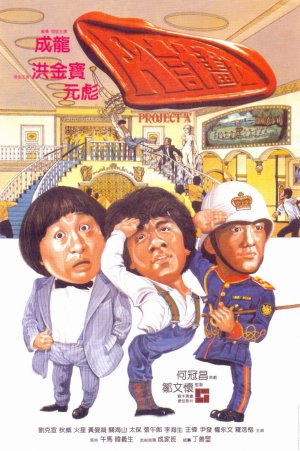
ProjectAOne thing Netflix does have a lot of is old Jackie Chan movies. I have to be careful to avoid the R-rated ones with Little Satis (it’s usually just for Chris Tucker‘s foul mouth), but there are plenty that are pretty much just harmless fun. A particular joy are those from the eighties before he moved to Hollywood, because some of them just don’t make any sense. We watched The Accidental Spy once (fair enough, that one’s from 2001), which is about a salesman who just happens to be a karate master. Fair enough.

At least in Project A Jackie Chan is an ex-cop turned sailor, so the martial arts is a little more explainable…maybe? Anyway, long story short, pirates are attacking the Chinese navy in Hong Kong, and despite all their efforts, they always seem to be one step ahead of the navy’s plans. The admiral, a kindly old man, is discharged, the ships abandoned, and naturally all the sailors become police officers. It turns out, however, that it was the police who were giving the information to the pirates in the first place. With the help of a shadowy, overweight kung-fu-chopping madman friend and a haughty police officer who nonetheless has his heart in the right place, our hero manages to fool the cops, bust an arms trade with the pirates, sneak into their island cove, duke it out with the super-badass pirate bad guy and escape just before it all blows to hell.

Frankly there isn’t a whole lot to be considered here. The whole thing feels a little bit like a Chinese James Bond film with martial arts. IMDB labels it as a “costume drama”, and the costumes certainly couldn’t be more dramatic. The pirates are wonderfully stereotyped, complete with swords and bare chests and pantaloons and drooping pencil mustaches:

535728-projecta_d

All in all, the main reason to watch this movie – the main reason to watch any Jackie Chan movie – is for the stunts, and of those there are numerous and spectacular examples. The cycling stunts through the back alleys of Hong Kong are splendid, and when Jackie Chan manages to climb to the top of a forty-foot flagpole, jump onto a roof and crash through a loft window, all with his hands manacled, my heart did actually do a little leap. Every fight scene is beautifully choreographed, which is simply a pleasure to watch. There is humor, but often the true laughs are at the attempts to deliberately be funny – the crudeness of the slapstick is itself amusing (for example, when Chan’s bicycle seat falls off without his knowing, and he sits down on the bare pole).

There was one thing about the film that stuck out to me, and it was something that I personally was very appreciative of. Unlike many of his more modern films (and unlike most films these days), the on-location filming in the streets and back alleys of Hong Kong lends a wonderful authenticity that is so often missing these days. No spectacular sets, no jumping out of airplanes or off skyscrapers; the story is a simpler one, and so the locations are simpler. It makes one realize that huge sets are very impressive and all, but it can actually take away from what you’re supposed to be impressed by: the actors, and the action.

★ ★ ★ ★ ☆

Movie Night: Time Bandits

Year: 1981

Director: Terry Gilliam

Production Company: HandMade Films

Leads: John Cleese, Sean Connery

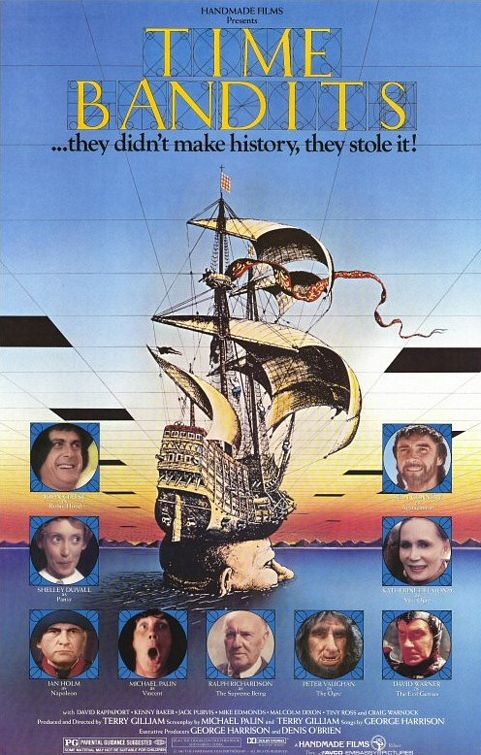
time_bandits_movie_poster_01Time Bandits is one of those wonderful films that I started watching many years ago, and somehow never got to finish (like Pulp Fiction – it was nearly ten years before I saw how it ended). Written alongside the Monty Python films, it shares many of the hallmark characteristics (and actors) of those inimitable televisual feasts, not the least of which is their complete and utter disregard for anything making any sense at all. Little Satis has not seen any Monty Python yet, but I suspect the time is coming.

In a nutshell, Kevin is a oppressed and imaginative 11-year-old who is whisked off by a band of six time-travelling dwarves in search of treasure, and on the run from the Supreme Being from whom their time map was stolen (still with me so far?). Enter a series of irreverent clashes with famous moments and figures in history, including Napoleon’s victory at the Battle of Castiglione, Robin Hood, and the sinking of the Titanic. The seven eventually end up in the Time of Legends, face off with Ultimate Evil in the Fortress of Ultimate Evil, and are rescued by the Supreme Being. Supreme Being sets things right, sends Kevin back to bed, and everything ends with a hunky-oh-it-was-just-a-dream feeling. Only…

Not giving that one away. All I’ll say is the ending to Time Bandits is one of the most paradoxical and nonsensical moments I’ve ever seen in film, and Little Satis and I were discussing for days afterwards.

It was interesting to watch this film with Little Satis, for he hasn’t grown up with the same British humor that I did. This film, along with pretty much all of the Monty Python canon, is a blend of slapstick, nonsense and subtle wit, and there were a number of times when I had to point out to Little Satis why something was funny.

The poor are going to be absolutely thrilled. Have you met them at all?

Who?

The poor.

The poor?

Oh you must meet them – I’m sure you’ll like them. Of course, they haven’t got two pennies to rub together, but that’s because they’re poor.

This is followed by a fellow who decks every person they give gold to – because it is necessary, actually. Dear me…John Cleese as Robin Hood couldn’t be more perfect. Then again, he couldn’t be more perfect as Napoleon’s extremely tall general; watching Ian Holm as Napoleon Bonaparte descending into a drunken stupor whilst rambling about extremely short military conquerors of the past is one of the most exquisitely funny things I’ve seen. But this was lost on Little Satis of course, because they don’t teach kids about the Napoleonic Wars these days in third grade.

There are some surprising twists in the film, and they are twists of the tiny and subtle kind. A pivotal point is when Agamemnon is talking to Kevin about finding his friends and returning home. He asks Kevin if he wouldn’t like to be with his own mother and father again, and where pretty much any other film would take the heartstring-puller “yes,” Gilliam goes for the “no; it’s much better here.”

Given the limits of technology and budget of the time, the visual effects are splendid. It helps, I suppose, that in keeping with Monty Python’s aesthetic there are many effects which are quite deliberately “obvious”, but effective nonetheless: the giant who rises from the sea with their ship on his head is, of course, simply a man with a ship on his head. Other sets – in particular the scenes in the Fortress of Ultimate Evil – are striking and impressive, and the scene in which the dwarfs swing on ropes from great iron cages above a bottomless abyss is genuinely heart-stopping.

Gilliam hits all the right notes with this gem; from slapstick and nonsense to pithy wit and genuine emotion, he directs a seasoned cast in a delightful fantasy that never takes itself too seriously, yet somehow feels as though it has a serious point to make. If only we could work out what it is…

If anyone else has seen Time Bandits, what were your thoughts about the ending? Is it genuinely impossible, or am I missing something?

★ ★ ★ ★ ★