Tales of Despair: The Triumph of Death

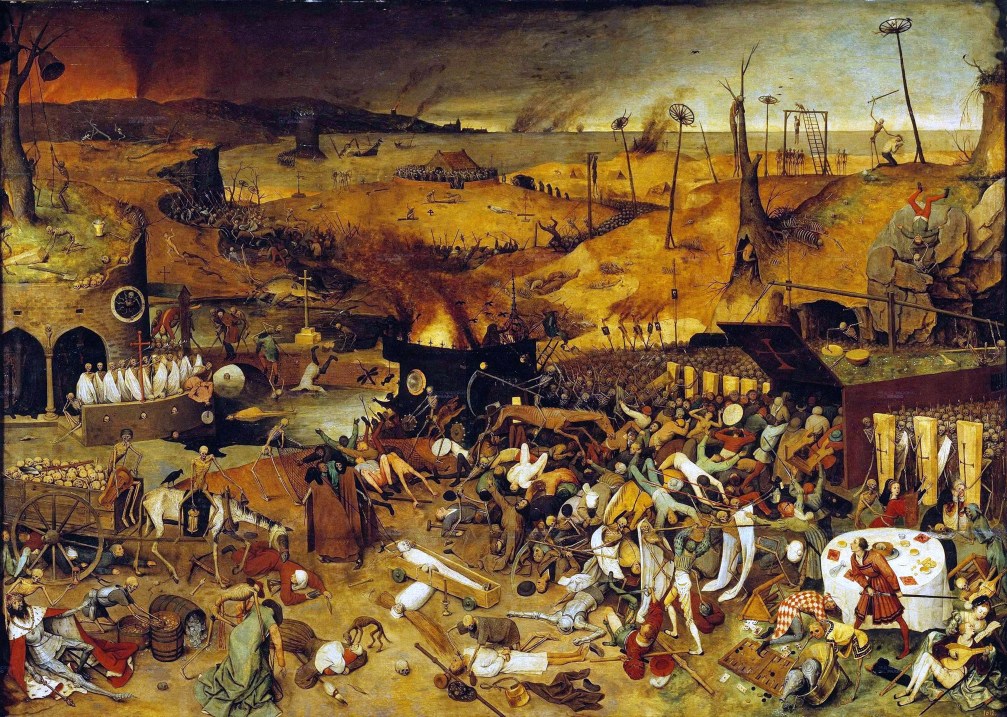
I am no student of art, and I know little of the medium and its history. However, I came across this painting some years ago, and even to my untrained eye it is exceptional for its time.

Pieter Bruegel (1525 – 1569) was a Flemish painter at the height of the Renaissance, when secular art began to be accepted in European culture, and people suddenly started painting people and fish, and not just god. Bruegel in particular has become renown for his paintings of everyday life, depicting peasants, hunters and even beggars, working hard to capture the scenes all around him (a kind of 16th-century George Bellows). In many of his works, however, he allowed fantasy to creep into the scenes, such as Landscape with the Fall of Icarus.

Detail showing a king, all his riches powerless to slow the advance of time, and the coming of his death.

Still, none of his paintings (including Dull Gret) come nearly as close to the dark and twisted nature of The Triumph of Death. This is a massive work – the original is some five feet across – and it portrays hundreds of figures, fallen upon by an army of death. There is too much here to even begin to go into, so complex is the entire painting, but there are some points within it that genuinely stand out to me.

Overall, it seems painting seems to emphasize death as the lord of all – kings and peasants as one fall victim to its clutches. In one corner, a great king, cape in ruins, cannot prevent a grinning skeleton from pillaging his gold. As a reminder of his despair, a second skeleton holds up an hourglass, driving home the fact that he will not long last in this world.

Detail showing a man and woman playing music, unaware of death mocking them behind; a moment of black humor in an otherwise bleak work.

The detail of the agony and despair in this painting is astonishing, and excruciating; every inch of canvas is covered by death. Even where there are people yet alive, death is yet hounding them. In one small detail, a man, stripped and naked, seeks refuge from the horror by hiding under the roots of a tree. It is, of course, futile – a spear protrudes from his back. In another, a man fleeing desperately, is set upon by the starved hounds of hell, while a skeleton looks on nonchalantly, waiting as they take down their prey. In particular, though, I am drawn to a small detail that shows two people – perhaps the only people in the entire painting – who seem unaware, or unaffected, by the death and torture around them. The man is playing a lute; the woman is singing from a songbook with him. The man looks worried, as though he perhaps should be thinking about something other than their music, but the woman rests a reassuring hand on his shoulder, and carries a calming expression, as though music is untouchable by death. In an inspired moment of irony, Bruegel adds a skeleton, hiding behind them, accompanying them both on the fiddle.

Church – and god – are no escape for the coming of death.

Though the Renaissance was, of course, a time of artistic awakening, religion was nonetheless and inescapable and fundamental part of culture, and every person’s life. Prayer, and the hope of an afterlife, was often the only consolation for peasants who slaved for a lord, starved, and grew ill with terrible disease. For Bruegel, however, even the church is unable to give deliverance from death; in what may have been nearly heretical at the time, he depicts the skeleton army invading the house of god, desecrating its windows, drowning people in its river, and mockingly calling the ring of silver trumpets. To the right, a very large portion of the canvas is given to showing the skeletons herding people in droves into a cross-embossed box, while their armies await on either side, holding shields bearing crucifixes. It is as though Bruegel was verily denouncing religion itself as false hope of life.

The scene is a grim twist on the artist’s nature and style. Whilst many of his works depict ordinary scenes of peasant life, here he takes a scene from almost every class imaginable, and treats them to the same horror and finality. The princes and the poor, the pious and the sinners, all succumb alike. In the distance, the fires of hell glow bright, while skeletons ring a great funeral bell. Ships burn on the horizon, and the earth is barren of all growth. The only life that seems to persist are the crows, likened as always to companions of death.

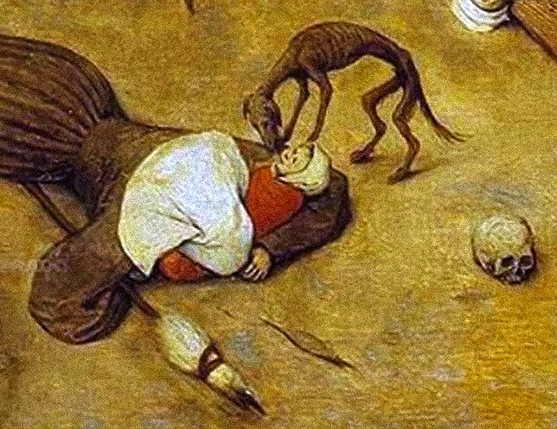
In Bruegel’s eye, death spares no one, and nothing. By the river, a large whale or dolphin lies butchered, and in the distance, skeletons hack at the few remaining trees. However, the true depth of the artist’s horror, and the epitome of death’s cruelty, is in a small detail at the bottom of the painting. Prostrate, a mother lies dying, her bundled infant dead in her arms. The true ghastliness of this scene, though, and the terrible truth of death, is the skeletal hound of hell, feasting on the dead child’s flesh.
Thought of the Week: Get Inside Their Head

A couple of things this week have got me thinking about the concept of empathy, and what it takes to actually think along someone else’s lines. This is something of a two-pronged thought, for the idea of being able to put yourself in someone else’s place is dreadfully important, both in fictional writing and in real life.

I owe the inspiration for this post to The Random Fangirl for her excellent post on bullying. Apart from the naturally troubling nature of such a subject, there was something she said at the end that really got me thinking:

And I didn’t understand. And I still don’t understand. Didn’t these people have parents who taught them better? Couldn’t they see the pain they were causing? Didn’t they care?

Now, empathizing with bullies – particularly those who abuse, harm and kill – may not sound very tactful. But bear in mind – empathy is not sympathy. I couldn’t help but wonder if I could understand, if I could out myself in the place of a person who could willingly cause such harm.

The initial reaction to this is to rationalize. Something must have happened to them in their youth. They must have terrible home lives. Perhaps they genuinely are psychopathic, and unable to understand the feelings of others.

The trouble is, this is the very antithesis of empathy – there is no emotion here. It is incredibly difficult and painful to force yourself to feel what another person feels – all the more so when you find their actions abhorrent. Think for the moment about the phrase “in one’s shoes”; the implication is of switching places, literally standing where the other person is.

Imagine you witness a terrible beating; a person is punching, kicking, tearing and clawing at another – or perhaps you – and will not stop, despite all the screams, the tears, the pleas and the blood. Now, imagine you are the person delivering the abuse. Don’t make yourself stop – continue beating that poor person within an inch of their life.

Why are you doing this? What terrible events could possibly have led you to enact such violence upon another person? What would possess you to continue kicking them in the teeth even as you look upon the blood and the tears and the fear?

And here is the crux – the crossing point into genuine empathy. Answer those questions, genuinely and from the heart. Don’t stop until you uncover the reasons why you would do such a terrible thing. It won’t be easy – you’ll almost certainly be outraged, and unwilling to acknowledge that you could ever be capable of such injustice, because it is so far from the core of your being.

But what makes you different from that terrible person? We are all of the same ilk at birth. For me, the only reason I have to descend with such viciousness upon someone is pure, blinding hate. Then I am given to ask – what could cause such hate, especially if this person hasn’t wronged me? Perhaps I am convinced they have – I see something within them that I am desperately jealous of. Perhaps I am terrified of them, and see no other option – like killing a wasp so it won’t sting me. Then a new question follows this – why am I jealous?

This line of thought will lead you to a great many questions, each one burying down into a new depth of your own soul, into places you didn’t even know existed, or worse, wouldn’t accept. This has taught me that I would most certainly be capable of such despicable actions – in just the right scenario and given the right set of circumstances that led to it. It will be torture to acknowledge these terrible parts of you, but if you can face it, if you can admit to your own failings and insecurities, you might find yourself suddenly able to understand behaviors that you, yourself could never dream of doing.

And this very same line of thought applies to creating the characters in your story. No matter how brilliant and inventive your plot, the entire story hinges on the believability of your characters. Unfortunately, this is probably the hardest part of writing. Hands up who is 100% confident of the quality of your dialogue. What’s that? Only a few? I’m right there with you. Why is it so hard to write convincing dialogue?

For me, part of the reason for this is the instinct to write dialogue out as though I was speaking it myself. All of it. Imagine watching a movie where every character spoke in the same way! Come to think of it, this does happen in film – think of someone like Johnny Depp. For all his brilliance as an actor, a huge number of his films rely on him being Johnny Depp, whether he allows it to run rampant (Pirates of the Carribbean) or tones it down (Charlie and the Chocolate Factory).

It becomes all too easy when coming up with a storyline for the characters to become the vehicle to carry the plot to its end. The difficulty here is that it can lead to shallow characters, who speak only to further the plot, and act as needed, not as they must.

So I would encourage you to do the same soul-searching for your characters as you would for other, real people. Imagine yourself stabbing someone in the back, or having to decide between saving your by friend or your lover. Forget the plot you intended – it might not work! Follow your character, see what they get up to, and above all, imagine yourself in their place, and then ask yourself: why would I have done this? Your characters – and your readers – will thank you.

Your friends just might, as well.

Thank You for the Support

Okay, so I’ve been running this blog since October 2011, mainly as a way of tracking my progress on the back history for The Redemption of Erâth, way back when it was part of the 2011 NaNoWriMo. When that endeavor finished, I more or less let things drop until after the new year.

I started picking this up a little bit after that, and began to use this blog as a voicing forum for my oddness and inner thoughts. To my great surprise, it appeared that there were at least a few fellows out there who felt I had something worth saying. I’m touched. No – really.

Sometime in the middle of last night, I received my 50th follower. This coincides with my 1,000th view about a week ago, and I wanted to acknowledge everyone who has supported my writing, either by reading it, liking it or (unthinkable!) following it. So this is basically a big, sloppy thank you to every single one of you who has made a connection with me over the past few months.

I know it’s still small – I see the blogs out there that boast hundreds of hits a day, and whose followers exceed three digits, but if I’m honest, I don’t mind my small little following, because I feel close and attached to every single one of you. Those who have made a particular impact on me can be discovered at the bottom of the page (you know who you are!); and for everyone else, I can’t wait to learn more about your own writing and thoughts.

Thank you most sincerely and whole-heartedly,

Satis – 2012